The GEO Playbook: What to Publish, and Where
Turn AI citation data into a plan: which platforms to prioritize, what to publish on each, and how to format content so AI models quote it.
TL;DR: Once you know which platforms each AI model cites, the plan almost writes itself. Overseas, prioritize Reddit, then YouTube and Wikipedia. In China, prioritize Zhihu and Toutiao, then the Sohu/NetEase network and CSDN. Format matters as much as placement: a first-paragraph definition is quoted over 70% of the time by ERNIE, and table comparisons are cited 47% more often than plain paragraphs by Qwen. This is part 2 of a two-part series. Part 1 maps the underlying citation data; this part turns it into what to publish, where, and how.
Key Takeaways
- The two highest-leverage moves cover 8 of 9 major models: deep Q&A on Zhihu paired with genuine participation on Reddit reaches both Chinese and overseas AI at once.
- Overseas priority order is Reddit (9.2/10), then YouTube (7.5) and Wikipedia (7.0). In China it is Zhihu (8.5) and Toutiao (7.8), then Sohu/NetEase (7.5) and CSDN (6.5).
- Format is a ranking factor for citation. A lead-paragraph definition is quoted over 70% of the time by ERNIE, table comparisons are cited 47% more than paragraphs by Qwen, and structured markup lifts citation weight about 35%.
- Match content cadence to each model's freshness rule: Toutiao and Doubao reward weekly updates, while technical posts for DeepSeek and Claude stay citable for months.
- Reach Claude only through deep content on your own domain, since it cites 0% from social platforms and favors deep `/blog/` paths.
- Treat GEO as a measured loop: publish, track which pages get cited, then move budget toward the platforms and formats that actually earn citations.
How should you turn the citation map into priorities?
Part 1 showed which platforms each model cites. The next question is where to spend limited time and budget. Combining each platform's citation weight across the models that use it gives a composite priority score. The chart below ranks platforms for both markets on a 0 to 10 scale.
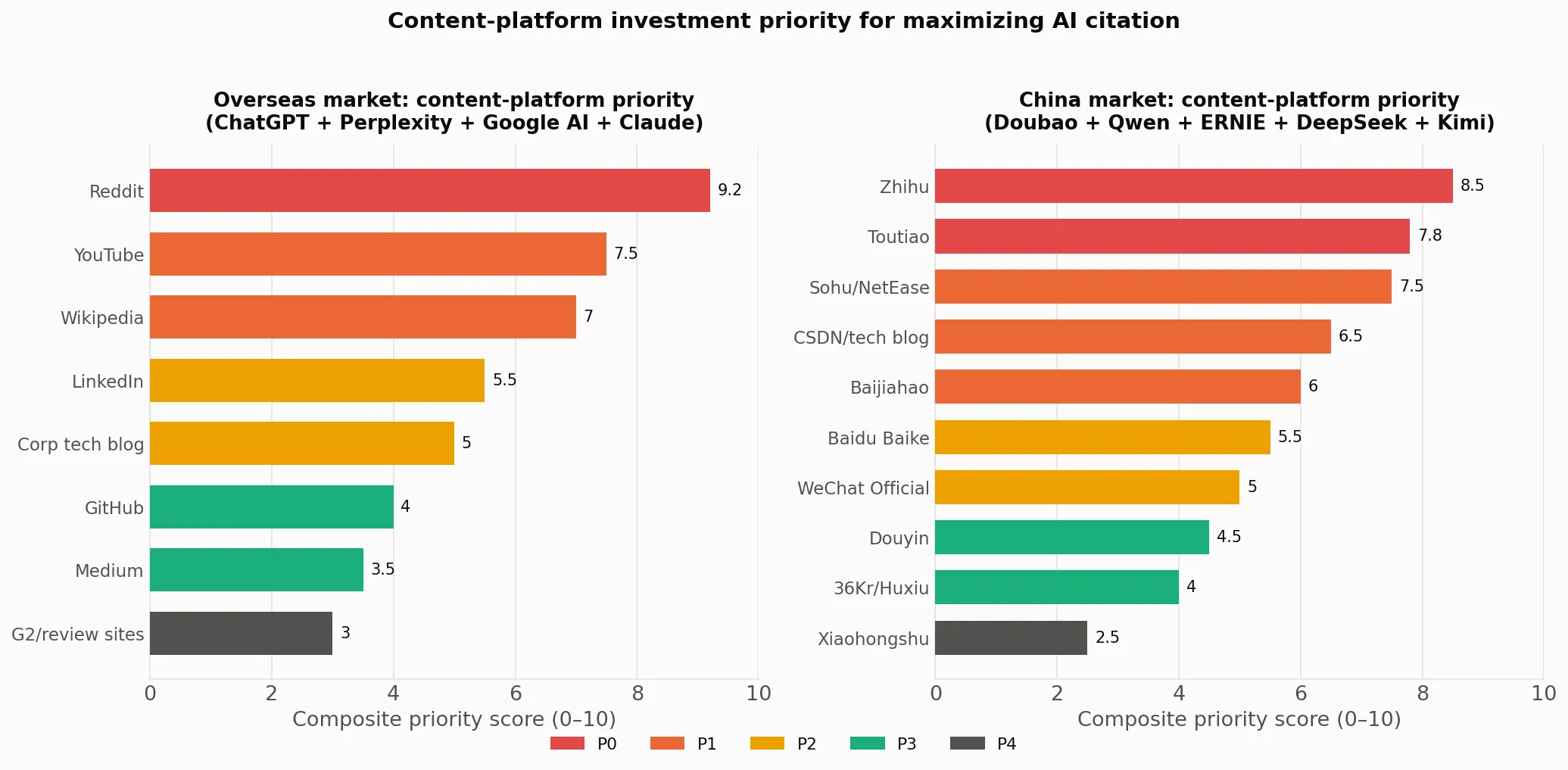
The scores are a starting allocation, not a law. If your audience skews heavily toward one model, weight that model's favorites higher. But as a default, the order below is where the citations are.
What is the priority order for overseas markets?
- P0, Reddit (9.2): the top source for Perplexity, Google AI, and ChatGPT combined. Real user reviews, technical Q&A, product comparisons.
- P1, YouTube (7.5): strong for Google AI and Perplexity. Product review videos, setup and how-to guides, side-by-side demos.
- P1, Wikipedia (7.0): the anchor for ChatGPT. Accurate brand and product entries.
- P2, LinkedIn (5.5): moderate weight for Google AI and Perplexity. Industry white papers and B2B case studies.
- P2, corporate technical blog (5.0): the main channel for Claude. Deep technical articles, API docs, white papers.
- P3, GitHub (4.0) and Medium (3.5): supporting reach for Claude and Google AI's long tail.
- P4, G2 and review sites (3.0): some ChatGPT weight through product reviews.
What is the priority order for Chinese markets?
- P0, Zhihu (8.5): the one platform every Chinese model cites. Deep Q&A, technical comparisons, buying guides.
- P0, Toutiao (7.8): the core source for Doubao. FAQ articles, industry trends, product explainers.
- P1, Sohu/NetEase network (7.5): strong for Qwen, DeepSeek, and Kimi. Industry analysis and objective reviews.
- P1, CSDN and technical blogs (6.5): the core for DeepSeek. Technical practice, algorithm walk-throughs, architecture.
- P1, Baijiahao (6.0): the absolute core for ERNIE. Authoritative explainers using a first-paragraph definition.
- P2, Baidu Baike (5.5) and WeChat Official Accounts (5.0): entity knowledge and deep research reports.
- P3, Douyin (4.5) and 36Kr/Huxiu (4.0): high weight but only for Doubao, and tech-media analysis.
- P4, Xiaohongshu (2.5): low direct citation, useful mainly for shaping search intent.
Which two moves give the best return?
If you can only do a few things, do these. They are ranked by how many models they reach per unit of effort.
The first move is deep Q&A on Zhihu paired with genuine participation on Reddit. Between them, these two platforms reach 8 of the 9 major models, Chinese and overseas at once. Both are UGC anchors that models treat as verified, first-hand knowledge, so a single strong answer can be cited for a long time.
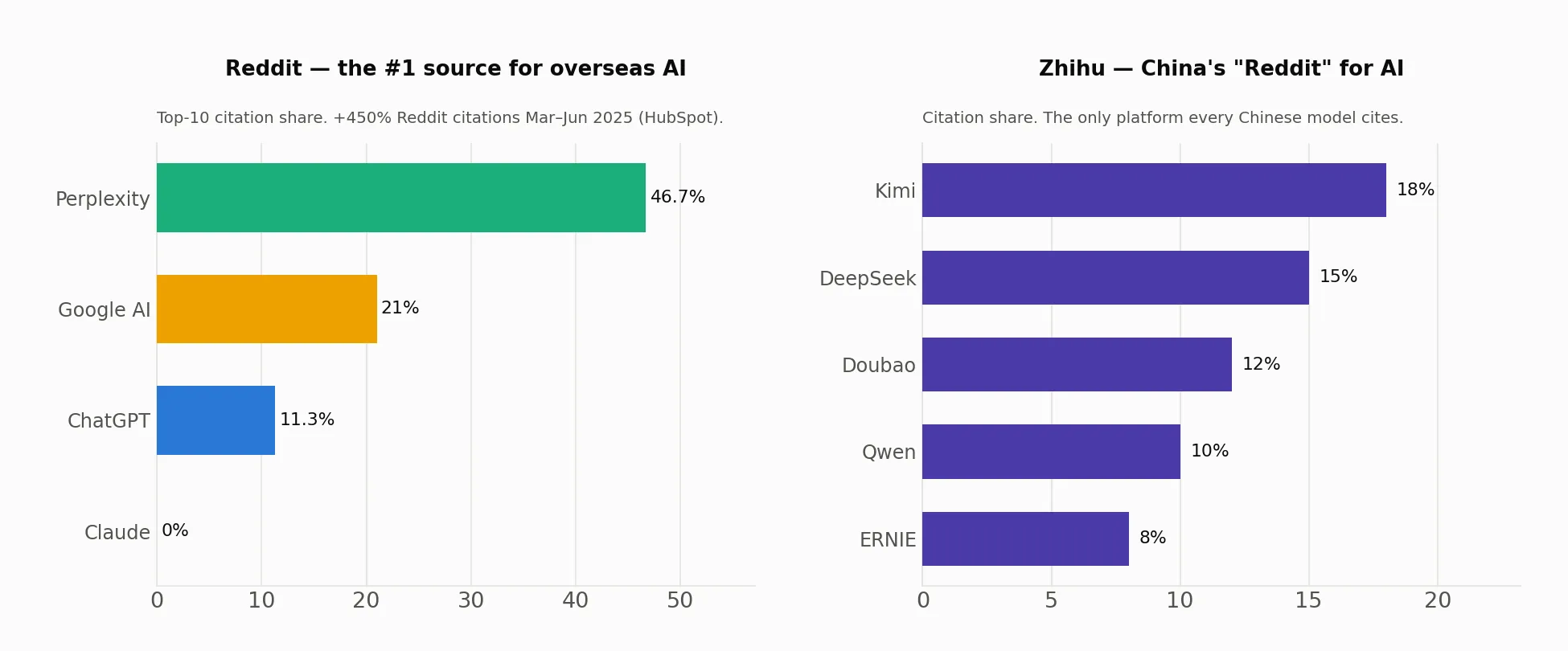
The second move is FAQ content on Toutiao paired with authoritative explainers on Baijiahao. Together they cover Doubao and ERNIE, which reach the largest Chinese user base. The third move, for overseas professional audiences, is YouTube review videos plus a strong corporate technical blog, which together cover Google AI and Claude.
How should you structure content so a model quotes it?
Placement gets you into the candidate pool. Format decides whether a model lifts your sentence into its answer. The measured effects here are large enough to treat as ranking factors.
Lead with the answer. ERNIE quotes the first-paragraph definition of a Baijiahao article more than 70% of the time. Whatever the platform, put the core conclusion and a clean definition in the opening sentence, not three paragraphs down. This is the same principle behind a good TL;DR: a self-contained, quotable statement that works without surrounding context.
Use tables for comparisons. Qwen cites table-formatted comparisons 47% more often than plain paragraphs, and structured markup such as lists and tables lifts citation weight by about 35%. A product or spec comparison belongs in a table, not prose.
Write for the model that reads you. DeepSeek parses Markdown well and extracts code blocks, including their comments, for separate analysis, so technical posts should include real code and architecture diagrams. Claude rewards depth on your own domain, so long technical articles and documentation matter more than social posts. Google AI and Perplexity lean on video, so a review or how-to on YouTube can enter answers that text alone would not.
Match cadence to the freshness rule. Toutiao and Doubao weight recent content heavily, with material strongest in its first one to two weeks, so those channels need a weekly rhythm. Technical content for DeepSeek and Claude stays citable for months, so depth beats frequency there. Running one cadence for both wastes effort on one side.
What does a concrete rollout look like?
A staged rollout keeps the work ordered and measurable. The phases below assume a brand starting close to zero on GEO.
Phase 1, foundation (months 1 to 2)
Establish identity and entity knowledge first. Create accurate brand and product entries on Wikipedia and Baidu Baike, since these feed ChatGPT and ERNIE respectively. Open and verify official accounts on Zhihu, Toutiao, and Baijiahao. Publish a first batch of genuine content on Reddit in the communities relevant to your category, written in a real user voice rather than as promotion.
Phase 2, content matrix (months 2 to 4)
Build a steady cadence across the priority platforms. A workable weekly plan: two to three FAQ or trend articles on Toutiao, one to two deep technical Q&A posts on Zhihu, one industry analysis piece on the Sohu/NetEase network, one authoritative explainer on Baijiahao with a definition-first opening, and two to three genuine Reddit posts. Add two to three CSDN technical articles and two to three YouTube review videos per month. Keep the formatting rules above in every piece.
Phase 3, measure and iterate (ongoing)
GEO is a loop, not a launch. Each month, check which of your pages are actually being cited by each model, then shift budget toward the platforms and formats that earn citations and away from those that do not. Watch for changes in model behavior, since citation rules move, and A/B test formats such as definition-first openings and comparison tables to confirm the effect on your own content.
Where should you not spend?
Two cautions save wasted budget. Do not pour resources into platforms that models barely cite today: Xiaohongshu sits below 3% across all models and Twitter/X below 0.2% for the overseas models. Both can shape what users ask an AI, so a light presence is fine, but neither earns direct citations now. And do not judge success by raw impressions or follower counts. The only GEO metric that matters is whether a model cites you, so track citations, not vanity reach.
The map from part 1 plus the priorities here give you a plan you can start this week. Begin with the two highest-return moves, apply the formatting rules to everything, and let citation data redirect your effort from there.
FAQ
What is the single highest-return GEO action?
Deep Q&A on Zhihu paired with genuine participation on Reddit. Between them these two platforms reach 8 of the 9 major AI models, covering Chinese and overseas engines at once. Both are UGC anchors that models treat as verified first-hand knowledge, so one strong answer can keep earning citations for a long time.
How much does content format affect whether AI cites you?
A lot. ERNIE quotes the first-paragraph definition of an article more than 70% of the time, Qwen cites table comparisons 47% more often than plain paragraphs, and structured markup such as lists and tables lifts citation weight by roughly 35%. Lead with a clean definition and use tables for comparisons.
How often should I publish for GEO?
It depends on the target model. Toutiao and Doubao reward freshness, weighting content most in its first one to two weeks, so those channels need a weekly cadence. Technical content aimed at DeepSeek or Claude stays citable for months, so depth matters more than frequency there.
How do I get cited by Claude specifically?
Publish deep content on your own domain. Claude cites 0% from social platforms and favors .ai domains and deep /blog/ paths, sending 63% of its citations to niche technical blogs, docs, and practitioner articles. A substantive technical blog and clear documentation are the way in, not social posting.
How do I measure GEO success?
Track whether AI models actually cite your content, not impressions or follower counts. Each month, check which of your pages appear as citations in each model's answers, then move budget toward the platforms and formats that earn citations. Treat it as a measured loop and A/B test formats to confirm what works for your content.
Sources
Priority scores and formatting effects in this article are derived from the citation data compiled in part 1: Profound (680M citations), Oltre.ai (2,170 Claude URLs), Conductor (1,056 data points across 7 engines), CSDN's four-platform field test (Mar 2026), xfunnel (250K citations), plus Sohu GEO research, Binance data, and the iClick 2026 GEO guide. Figures are current as of mid-2026.
Subscribe to the newsletter
About the Author
Aaron is an engineering leader, software architect, and founder with 18 years building distributed systems and cloud infrastructure. Now focused on LLM-powered platforms, agent orchestration, and production AI. He shares hands-on technical guides and framework comparisons at fp8.co.
Cite this Article
Related Articles
Where AI Models Get Their Sources: A GEO Data Map
Reddit drives 46.7% of Perplexity's top citations, Wikipedia 47.9% of ChatGPT's. A data map of which platforms each AI model cites, from 680M citations.
GEOTraditional vs AI Search: SEO in 2026
Learn how AI search is reshaping SEO in 2026. Zero-click searches hit 93% and Generative Engine Optimization is the new frontier.
AI SearchContext Engineering for AI Agents: Cost and Reliability
Learn how caching, tool selection, memory and retrieval shape agent context, with cost calculations, failure cases and an evaluation checklist.
AI EngineeringThe Evolving Landscape of Generative AI
A practical map of foundation models, AI agents, data value, MCP, and A2A architecture shaping the modern generative AI ecosystem.
Generative AI