Where AI Models Get Their Sources: A GEO Data Map
Reddit drives 46.7% of Perplexity's top citations, Wikipedia 47.9% of ChatGPT's. A data map of which platforms each AI model cites, from 680M citations.
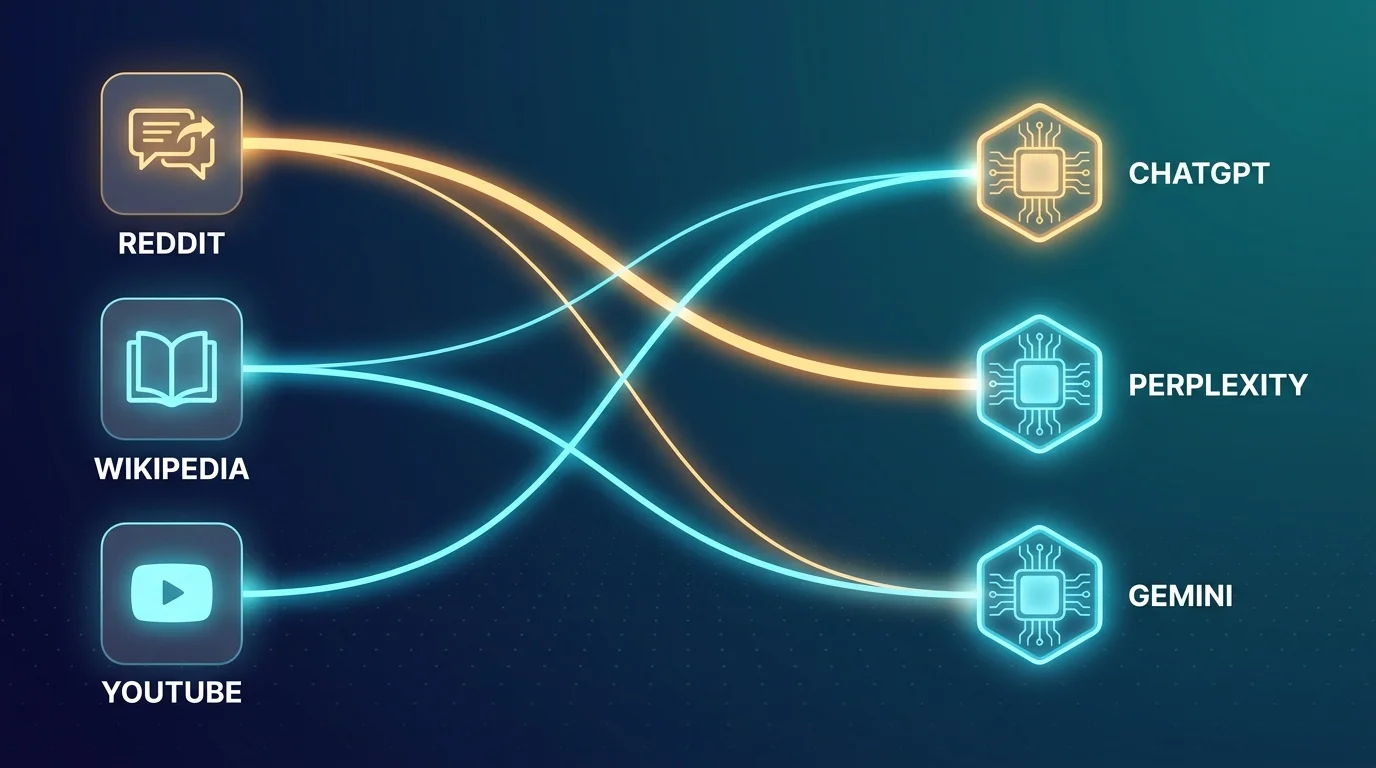
TL;DR: Different AI models pull from different corners of the web. Reddit supplies 46.7% of Perplexity's top-10 citations, while Wikipedia supplies 47.9% of ChatGPT's. Claude cites almost no social platforms and leans on niche technical blogs instead. Chinese models split along their parent companies: Doubao takes 60% of its sources from ByteDance properties, ERNIE 55% from Baidu. This article maps the citation preference of each major model using Profound's analysis of 680 million citations plus field data from Conductor, CSDN, and others. It is part 1 of a two-part series; part 2 turns the map into a publishing plan.
Key Takeaways
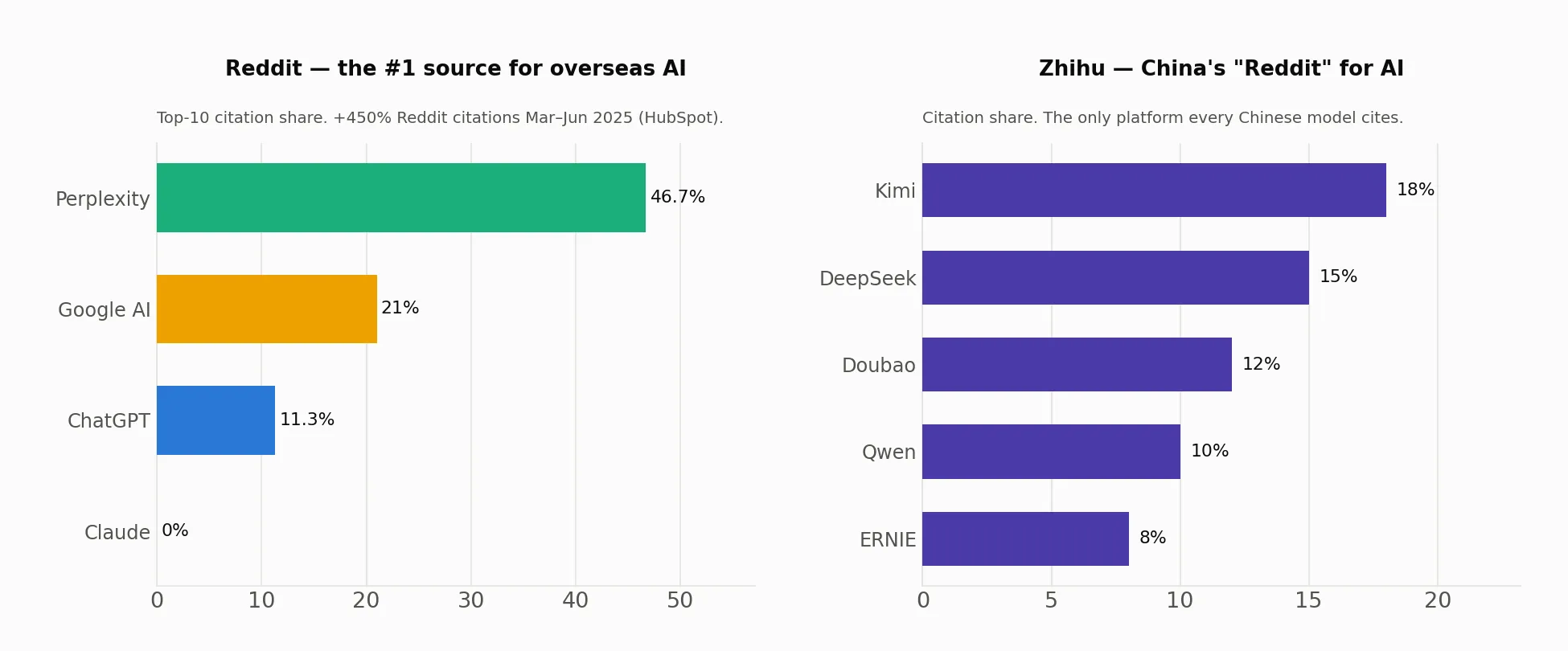
- Reddit is the single largest citation source for overseas AI. It accounts for 46.7% of Perplexity's top-10 citations, 21.0% of Google AI's, and 11.3% of ChatGPT's, and Reddit citations grew 450% between March and June 2025.
- ChatGPT is anchored to Wikipedia, which fills 47.9% of its top-10 slots. No other platform comes close for that model.
- Claude behaves unlike the others. It cites 0% from Reddit, LinkedIn, YouTube, Medium, and Quora, and sends 63% of its citations to niche SaaS blogs, docs pages, and practitioner articles.
- Chinese models show a walled-garden effect. Doubao draws about 60% of its citations from ByteDance's Toutiao and Douyin; ERNIE draws about 55% from Baidu's Baijiahao and Baidu Baike.
- Zhihu is the one platform every Chinese model cites, from 8% (ERNIE) up to 18% (Kimi). It plays the role Reddit plays overseas.
- Content freshness requirements vary widely. Doubao favors material updated within one to two weeks, while DeepSeek keeps citing technical content for months.
Why does it matter which sources an AI model trusts?
Search is shifting from a list of blue links to a synthesized answer with a handful of citations. When a model answers a question about your product, it does not survey the whole web evenly. It reaches for a small set of sources it has learned to trust, and those sources differ from one model to the next.
That is the core idea behind generative engine optimization, or GEO: instead of optimizing for a ranking position, you optimize for being one of the sources a model pulls into its answer. To do that well, you need to know which platforms each model actually cites. Guessing wastes effort on channels a given model ignores.
The data below comes from several measured studies rather than opinion. Profound analyzed 680 million citations across ChatGPT, Perplexity, and Google AI between August 2024 and June 2025. Oltre.ai looked at 2,170 URLs cited by Claude. Conductor tracked 1,056 data points across seven AI engines from September 2025 to March 2026. For Chinese models, CSDN ran a four-platform field test in March 2026, cross-checked against Sohu GEO research, Binance data, and xfunnel's 250,000-citation study. The numbers carry the usual caveats, which I cover at the end, but the patterns are consistent enough to plan around.
Which platforms do overseas AI models cite most?
The clearest way to see the differences is to compare each platform's share of the top-10 cited sources per model. The chart below shows that share for the three models Profound measured directly.
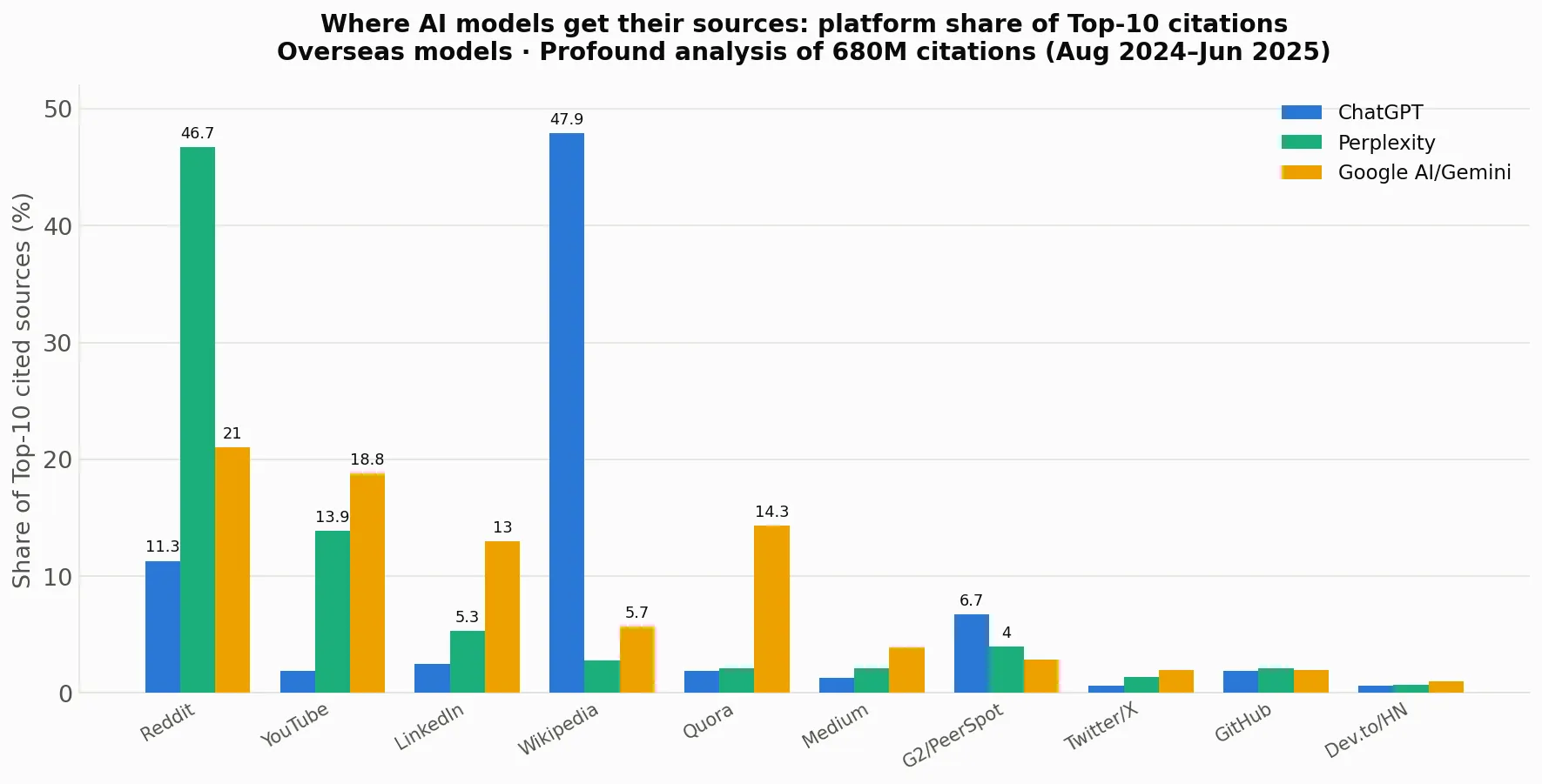
Two things jump out. Reddit and Wikipedia are not just high, they are dominant for specific models, and the rest of the field is comparatively flat. A second view, weighting by each platform's share of all citations rather than just the top 10, sharpens the picture and adds Claude:
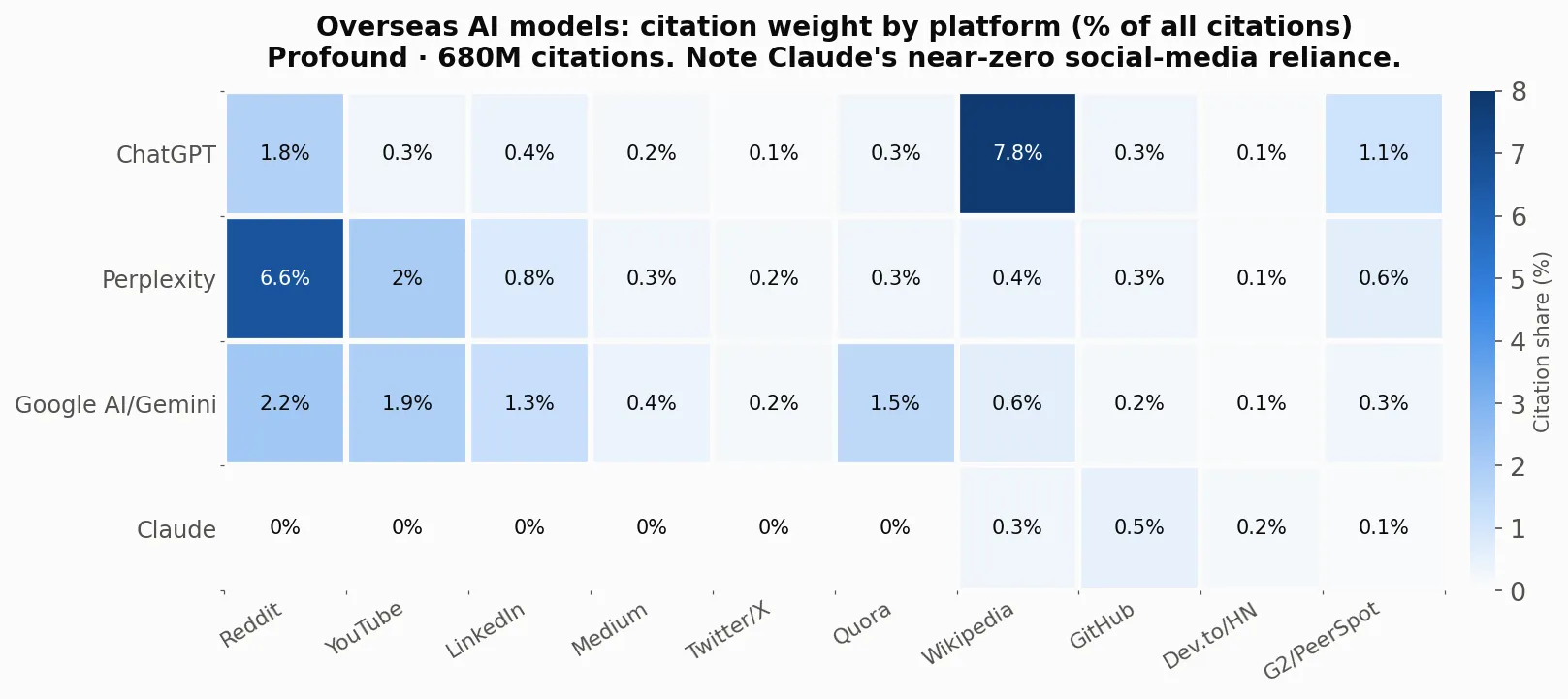
Claude's row is almost entirely zeros across the social platforms. That is not a rounding artifact. It reflects a genuinely different sourcing strategy, which I break down below.
How does ChatGPT choose sources?
Wikipedia is ChatGPT's anchor. It fills 47.9% of the model's top-10 citations, roughly four to eight times the weight of any other platform. Reddit comes second at 11.3%, and news media such as Forbes comes third. Among user-generated content, Reddit is the only social platform ChatGPT cites in meaningful volume. B2B review sites like G2 carry some weight at 6.7%, while YouTube, LinkedIn, and Medium barely register.
The practical read: an accurate, well-structured Wikipedia entry for your brand or product is the most direct route into a ChatGPT answer.
How does Perplexity choose sources?
Reddit is Perplexity's overwhelming first source at 46.7% of top-10 citations, the heaviest Reddit reliance of any model measured. YouTube is second at 13.9%, so video carries real weight here. Review sites such as Yelp and TripAdvisor sit around 9.9%, and LinkedIn has a modest presence at 5.3%. The Reddit dependence is also growing fast: HubSpot data showed Reddit citations up 450% from March to June 2025.
How does Google AI (Gemini) choose sources?
Google AI has the most even distribution. Reddit at 21.0% and YouTube at 18.8% run neck and neck, with no single platform dominating. Quora is surprisingly strong at 14.3%, third behind the two leaders, and LinkedIn has a real presence at 13.0%. Conductor's study found Gemini cited YouTube across nearly every search intent it tested, which fits Google's ownership of the platform. Video is a core advantage in this ecosystem.
Why does Claude behave so differently?
Claude cites zero from Reddit, LinkedIn, YouTube, Medium, Quora, and Hacker News. Instead, 63% of its citations point to niche SaaS blogs, documentation pages, or practitioner articles, and only 7% go to mainstream news domains. Oltre.ai's URL analysis found Claude prefers .ai domains (28.1% of citations) and deep /blog/ paths (56%), with homepage citations at just 3%. It rewards depth over social proof.
If Claude matters to your audience, the lever is a high-quality technical blog with substantive articles and clear documentation, not social posting.
Which platforms do Chinese AI models cite most?
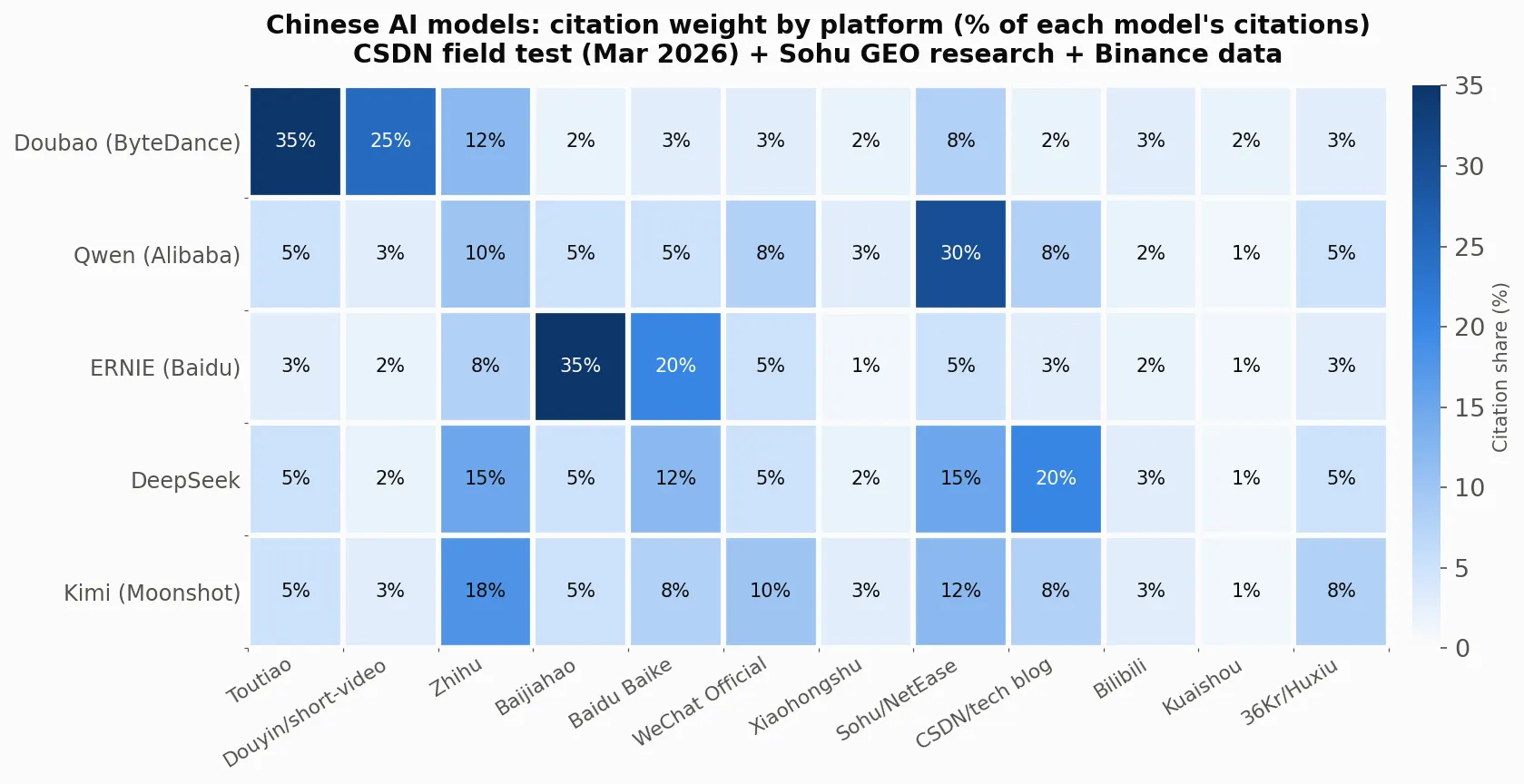
Chinese models tell a different story, and the dominant theme is the walled garden. Each large platform owner tends to feed its own model first. The heatmap below shows each platform's share of a given model's citations, from CSDN's March 2026 field test.
How do the Chinese models split by ecosystem?
Doubao, from ByteDance, takes 35% of its citations from Toutiao and 25% from Douyin, so 60% comes from ByteDance's own properties. Binance data put the figure even higher, noting that about 85% of Doubao's answer material comes from ByteDance sources. Its content also ages fast: material is weighted most heavily in the first one to two weeks, and citation rates drop sharply after a month. High-follower accounts carry roughly ten times the weight of ordinary ones.
ERNIE, from Baidu, mirrors this with 35% from Baijiahao and 20% from Baidu Baike, so 55% comes from the Baidu ecosystem. One striking detail from the research: the first-paragraph definition in a Baijiahao article has a better than 70% chance of being quoted directly, which makes the opening sentence the highest-value real estate.
Qwen, from Alibaba, is different. Its largest source is the Sohu and NetEase self-media network at 30%, with Zhihu at 10% and CSDN at 8% as support. The research noted Qwen cites table-formatted comparisons 47% more often than plain paragraphs, and that structured markup (lists and tables) lifts citation weight by about 35%.
DeepSeek has no captive ecosystem, which shows in a more even spread: CSDN technical blogs at 20%, the Sohu/NetEase network at 15%, and Zhihu at 15%. It favors hands-on technical writing over marketing copy, parses Markdown well, and extracts code blocks (with comments) for separate analysis.
Kimi, from Moonshot, leans most on Zhihu at 18%, followed by the Sohu/NetEase network at 12% and WeChat Official Accounts at 10%, the highest WeChat weight of any model. It prefers deep research content such as academic papers and industry reports.
Why is Zhihu the Chinese equivalent of Reddit?
Zhihu is the one platform every Chinese model cites: Kimi 18%, DeepSeek 15%, Doubao 12%, Qwen 10%, ERNIE 8%. A LinkedIn study put the average Chinese-model citation rate for Zhihu around 21%. The parallel to Reddit is exact in function. Both are the UGC professional-content source that AI models trust most, because both are full of first-hand experience, product comparisons, and worked solutions, which is exactly what a model needs when answering a real question.
What are the sharpest patterns across all models?
A few findings hold up across the whole dataset and are worth committing to memory:
- Reddit is the first source for overseas AI, and Zhihu is its counterpart for Chinese AI. Between them they touch almost every model, which makes them the highest-leverage platforms in the map.
- Video is rising fast. YouTube reaches 18.8% for Google AI and 13.9% for Perplexity, so a product review video can enter answers those models generate.
- Claude needs its own plan. With 0% social citations, it is reachable only through deep technical content on your own domain.
- The walled-garden effect is real for Chinese models but not for all of them. DeepSeek and Kimi stay relatively neutral, so quality technical and research content can reach them without a platform allegiance.
- Some platforms are near-useless for citations today. Every model cites Xiaohongshu below 3%, and Twitter/X sits under 0.2% for the overseas models. Both may still shape what users ask an AI, but neither earns direct citations now.
- Freshness is not one rule. Doubao wants weekly updates; DeepSeek keeps citing solid technical posts for months. The same content calendar will not serve both.
What are the limits of this data?
A few honest caveats before you act on any of it. The Chinese-model figures come from third-party field tests and industry research rather than a single large study like Profound, so their precision is lower. Citation rules change continuously as models and their retrieval pipelines evolve; these numbers run through mid-2026. Preferences can also vary by industry, since a model answering a home-electronics question may weight platforms differently than one answering a finance question. And platform behavior can shift overnight: if Xiaohongshu opens its content to more crawlers, its near-zero citation rate could rise.
With those caveats noted, the map is stable enough to plan around. Part 2 of this series turns it into a concrete publishing plan: which platforms to prioritize, what to publish on each, and how to structure content so a model quotes it.
FAQ
Which platform do AI models cite most overall?
It depends on the model. For overseas AI, Reddit leads, supplying 46.7% of Perplexity's top-10 citations, 21.0% of Google AI's, and 11.3% of ChatGPT's. ChatGPT itself is anchored to Wikipedia at 47.9%. For Chinese models, Zhihu is the one platform every model cites, and each large model also leans on its parent company's properties.
Why does ChatGPT rely so heavily on Wikipedia?
Wikipedia offers structured, encyclopedic, and comparatively well-verified entries, which suits how ChatGPT selects authoritative sources. It fills 47.9% of the model's top-10 citations, roughly four to eight times the weight of any other single platform, so an accurate Wikipedia entry is the most direct path into a ChatGPT answer.
Why does Claude cite so few social platforms?
Claude sends 0% of its citations to Reddit, LinkedIn, YouTube, Medium, and Quora. Instead, 63% go to niche SaaS blogs, documentation, and practitioner articles, and it favors .ai domains and deep /blog/ paths. It rewards depth and first-hand technical writing over social proof, so reaching it means publishing substantive content on your own domain.
What is the walled-garden effect for Chinese AI models?
Several Chinese models draw most of their citations from their parent company's platforms. Doubao (ByteDance) takes about 60% from Toutiao and Douyin, and ERNIE (Baidu) about 55% from Baijiahao and Baidu Baike. DeepSeek and Kimi are the exceptions, staying relatively neutral and citing quality technical and research content regardless of who owns the platform.
Is Xiaohongshu worth targeting for AI citations?
Not for direct citations today. Every model cites Xiaohongshu below 3%, and 36Kr reported it did not enter any model's citation top-10. Its content is mostly images plus short text, which is hard for models to extract. It can still shape the questions users bring to an AI, so it has indirect value, but it should not be a core GEO investment right now.
Sources
Data in this article comes from: Profound (analysis of 680M citations, Aug 2024 to Jun 2025); Oltre.ai (2,170 Claude-cited URLs, 2025); Conductor (1,056 data points across 7 AI engines, Sep 2025 to Mar 2026); CSDN four-platform field test (Mar 2026); xfunnel (250K citations, 2025 to 2026); plus Sohu GEO research, Binance data, HubSpot Reddit-growth data, and the iClick 2026 GEO guide. Figures are current as of mid-2026.
Subscribe to the newsletter
About the Author
Aaron is an engineering leader, software architect, and founder with 18 years building distributed systems and cloud infrastructure. Now focused on LLM-powered platforms, agent orchestration, and production AI. He shares hands-on technical guides and framework comparisons at fp8.co.
Cite this Article
Related Articles
Traditional vs AI Search: SEO in 2026
Learn how AI search is reshaping SEO in 2026. Zero-click searches hit 93% and Generative Engine Optimization is the new frontier.
AI SearchThe GEO Playbook: What to Publish, and Where
Turn AI citation data into a plan: which platforms to prioritize, what to publish on each, and how to format content so AI models quote it.
GEOContext Engineering for AI Agents: Cost and Reliability
Learn how caching, tool selection, memory and retrieval shape agent context, with cost calculations, failure cases and an evaluation checklist.
AI EngineeringThe Evolving Landscape of Generative AI
A practical map of foundation models, AI agents, data value, MCP, and A2A architecture shaping the modern generative AI ecosystem.
Generative AI