Traditional SEO vs Inference Traffic: Complete 2026 Guide
Traditional SEO drives clicks through rankings; inference traffic converts through AI citations. Learn which strategy fits your content goals in 2026.
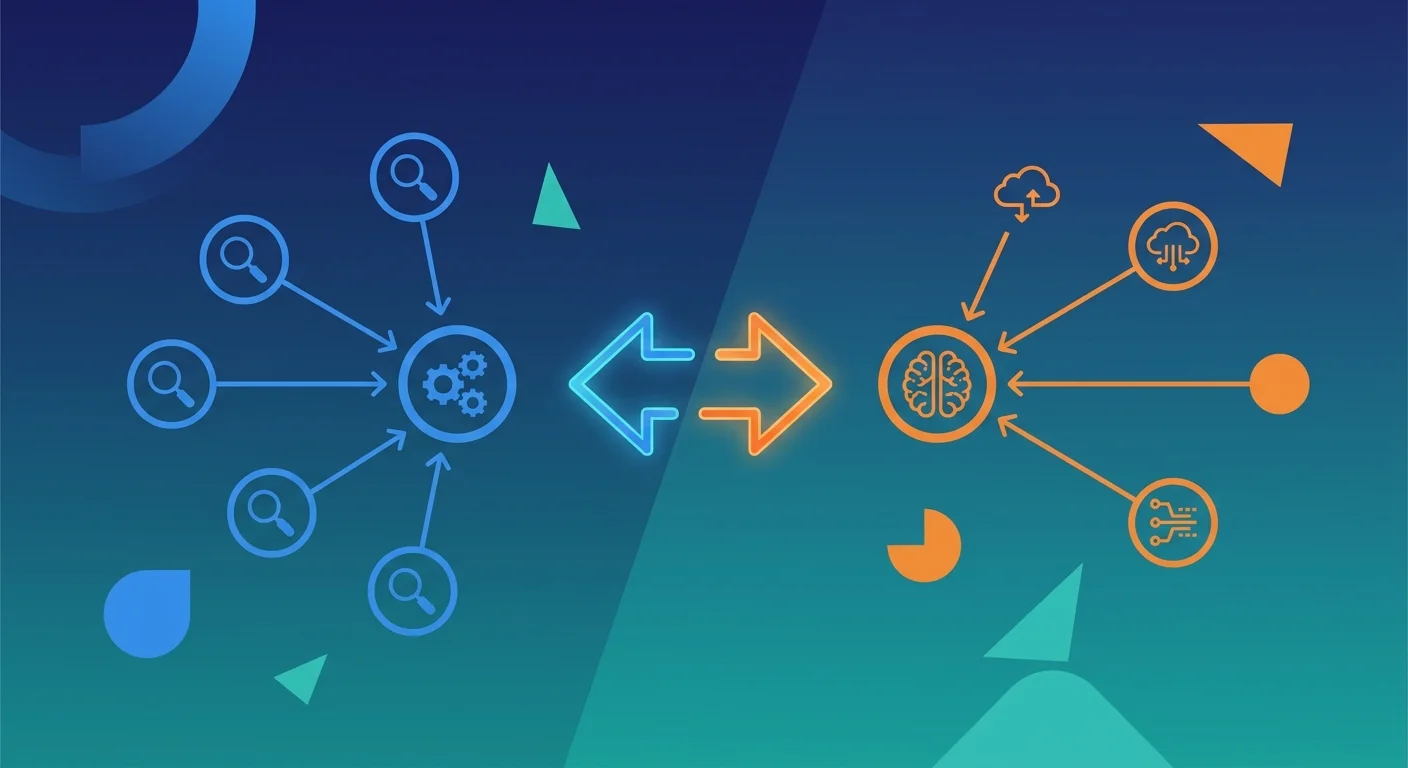
TL;DR: Traditional SEO optimizes for click-through via search rankings and measures success in organic sessions; inference traffic optimizes for AI citation and measures success in brand mentions, conversions, and downstream attribution from LLM-generated responses. As 93% of AI-mode searches end without a click, inference traffic now converts 31% higher for e-commerce and 9× higher for B2B despite lower volume, making it the higher-leverage channel for authority-driven content strategies.
Key Takeaways
- Traditional SEO targets Google's ranking algorithm to earn page-one positions and clicks; inference traffic targets the citation logic of LLMs like ChatGPT, Perplexity, Claude, and Gemini to earn mentions in generated responses.
- Inference traffic converts dramatically higher despite lower volume: 1.81% vs 1.39% for e-commerce and 15.9% vs 1.76% for B2B, because AI handles the research phase and sends only high-intent users.
- The measurement models diverge completely: SEO tracks rankings, impressions, and sessions in Google Search Console; inference traffic requires AI-specific analytics, citation monitoring, and multi-touch attribution to capture zero-click value.
- Content structure determines citability: question-based H2 headings, first-paragraph definitions, and tables lift AI citation rates 35–70%, while traditional SEO still rewards keyword density and backlink profiles.
- The two strategies are not mutually exclusive but serve different goals: traditional SEO remains essential for direct-response traffic and transactional queries, while inference traffic dominates for thought leadership, developer education, and complex B2B decision cycles.
What is the difference between traditional SEO and inference traffic?
The distinction begins with where the user sees your content and what happens next. Traditional SEO aims to place your page at the top of a search engine results page (SERP) so a human clicks through to your site. Success is measured in rankings, impressions, click-through rates, and sessions. Inference traffic comes from AI models citing your content inside a generated response, often without the user ever visiting your site. Success is measured in citations, brand mentions, conversions from AI referrals, and downstream attribution when users arrive days or weeks later having already formed intent.
Traditional SEO is a click-acquisition strategy built on Google's PageRank-descended algorithm. You earn authority through backlinks, optimize on-page elements for target keywords, and compete for position zero or the top three organic results. When successful, a user sees your link, clicks it, and lands on your page, where you have full control over the conversion funnel. Analytics platforms like Google Analytics capture the entire session, and attribution is straightforward: organic search → session → conversion.
Inference traffic is a citation-and-influence strategy built on how LLMs construct responses. AI models like ChatGPT, Perplexity, Claude, and Gemini retrieve, rank, and synthesize information from multiple sources, then generate a natural-language answer that may cite your content by name or URL — or may paraphrase it without attribution. The user often never clicks through. When they do, the journey is non-linear: they may read the AI's summary today, research further tomorrow, and visit your site a week later via a branded search or direct navigation. Traditional analytics miss most of this.
The core trade-off is volume versus intent quality. Traditional SEO can drive thousands of sessions per month if you rank well for high-volume keywords, but much of that traffic is exploratory, low-intent, and bounces quickly. Inference traffic delivers far fewer direct sessions, but those sessions come from users who have already been pre-qualified by the AI's research phase and arrive with specific, high-intent questions. This is why AI referral traffic converts 31% higher for e-commerce and nearly 9× higher for B2B despite representing a smaller absolute number of visits.
Why does inference traffic convert so much higher?
The conversion gap — 31% higher for e-commerce and 9× higher for B2B — is not a measurement artifact. It reflects a fundamental shift in where the research burden falls. Traditional organic search sends users to your site at the beginning of their research journey. They are comparison-shopping, exploring alternatives, and often leaving to check competitors before making a decision. Your site is one stop in a multi-site, multi-day process. Bounce rates are high, time-on-site is low, and conversion requires capturing the user's attention, educating them, and persuading them — all within a single session window that analytics can track.
Inference traffic sends users at the end of their research journey. The AI has already done the comparison, filtered options, explained trade-offs, and synthesized recommendations. By the time a user clicks through from an AI-cited source, they have a specific question ("Where do I buy this?") or have already decided and are seeking the transaction page. This phenomenon is called intent compression: the AI collapses what used to be a multi-session, multi-site research phase into a single conversation, and the user arrives at your site only when ready to act.
The B2B multiple is even more dramatic because B2B buying cycles are longer, involve more stakeholders, and depend heavily on perceived authority. When an AI model cites your white paper or technical guide as the definitive source, it confers third-party validation that no amount of on-page SEO can replicate. A user arriving via that citation path has already been told "this company is the authority," which short-circuits weeks of credibility-building that would otherwise happen on your site.
The trade-off is volume. A page ranking #1 for a keyword with 10,000 monthly searches might drive 1,500 organic sessions at 15% CTR. That same page, if cited by ChatGPT in 500 conversations, might generate only 35 direct referral sessions at 7% CTR — but those 35 sessions convert at 15.9% instead of 1.76%, producing 5.6 conversions versus 26 from the SEO channel. SEO wins on absolute conversions in this example, but the inference channel delivers higher revenue per session ($3.65 vs $3.30) and does so without requiring the user to sift through ten competing results first.
The second-order effect is even more valuable: users influenced by AI citations but not directly referred. A user reads a ChatGPT response citing your API as "the industry standard," doesn't click through that day, but returns a week later via branded search or direct navigation. Traditional attribution models assign zero credit to the AI interaction because there was no referral session. The influence happened in a zero-click environment, yet it directly caused the conversion. Measuring this requires multi-touch attribution that includes AI exposure as a trackable event, not just a referral source.
How do you measure inference traffic when most citations are zero-click?
The analytics gap is the single biggest operational challenge. Google Analytics, Search Console, and every major web analytics platform were built for a click-based world. They record a session when a user lands on your site, not when an AI reads your content to answer someone else's question. A traditional SEO campaign reports rankings, impressions, clicks, and conversions in a clean funnel. An inference traffic campaign must instrument an entirely new measurement stack.
The core metrics for inference traffic are citation volume, citation reach, brand mention share, and downstream attributed conversions. Citation volume is the raw count: how many times did an AI model cite your content in a given period? Citation reach is the user-facing number: how many users saw those citations, even if they didn't click? Brand mention share is your percentage of total citations in your category. Downstream attributed conversions are the sessions that arrived via branded search, direct navigation, or referral from a secondary source after the user's initial AI interaction.
Tracking citations requires either manual sampling or automated monitoring. Manual sampling means running representative queries through each major AI model weekly and recording which sources are cited. This is labor-intensive but captures the full user experience, including how your content is framed and whether the citation is positive, neutral, or unfavorable. Automated monitoring uses APIs where available (Perplexity's API includes citation metadata; ChatGPT's does not) or scraping tools that run queries and parse citations. Both approaches are proxies; no AI model currently provides a Search Console equivalent that reports "your content was cited N times this month."
Multi-touch attribution bridges the zero-click gap by tagging conversions that followed an AI interaction, even without a direct referral. The most practical implementation tracks branded search and direct navigation as proxy metrics. If your branded search volume and direct traffic both increase following a spike in AI citations, and your traditional SEO metrics remain flat, the lift is attributable to inference. More sophisticated setups use survey funnels ("How did you first hear about us?") and post-conversion interviews to capture "I read about you in ChatGPT" responses that never appear in referrer logs.
Engagement metrics shift from session-based to content-based. Traditional SEO measures bounce rate, pages per session, and time on site. Inference traffic measures citation depth (was your content quoted verbatim or summarized?), citation context (positive recommendation or neutral mention?), and co-citation network (which other sources were cited alongside yours?). A high-quality citation is one where your content is the primary source, quoted or paraphrased at length, and framed as authoritative. A low-quality citation is a passing mention in a list of ten sources with no distinguishing context.
The measurement challenge compounds when tracking ROI. Traditional SEO has a clear cost structure: content production, technical optimization, link building, and tools. Inference traffic adds multi-platform publishing (Reddit, YouTube, Zhihu), citation monitoring tools, and AI-specific content optimization. The return is split between direct referral conversions (trackable) and zero-click influence (estimated via proxies). CFOs trained on cost-per-acquisition models often reject proxy-based attribution, which makes selling inference traffic investment internally harder despite its superior conversion rate on the trackable subset.
What content structure works for traditional SEO versus inference traffic?
The formatting divergence is one of the clearest operational differences. Traditional SEO content is written for a human reader arriving on your page from a SERP. It follows established content marketing patterns: an H1 title with the target keyword, an engaging introduction, subheadings that break the article into scannable sections, internal links to other pages, and a call-to-action near the end. The structure optimizes for time on site, scroll depth, and conversion once the user has arrived.
Inference traffic content is written for an AI parser that may never send a human to your page. It follows question-answer patterns that LLMs can extract and reformat. Every H2 is a natural-language question, because that is the query the AI is trying to answer. The first paragraph under each H2 contains a direct, quotable answer in under 40 words, because that is what the AI will lift verbatim into its response. Tables, lists, and definition blocks are used liberally, because LLMs cite structured content 35–47% more often than prose paragraphs.
Question-based headings are the highest-leverage change. Traditional SEO might use a subheading like "Benefits of Our API" or "Key Features." Inference traffic uses "What are the benefits of this API?" or "Which features matter most for production use?" The latter phrasing matches how users ask the AI, which makes your content the natural source when the model constructs its answer. ERNIE, a Chinese LLM, cites first-paragraph definitions over 70% of the time, so a well-structured H2 + definition pair is essentially guaranteed placement in responses on that model.
Tables are the second structural lever. A comparison table of "Feature A vs Feature B" is cited 47% more often by Qwen than the same information written as paragraphs. This holds across models: structured data is easier for an LLM to parse, verify, and reformat, so it gets cited more. A traditional SEO article might describe three pricing tiers in prose; an inference-optimized article puts them in a three-column table with feature checkmarks, because that table can be directly embedded or converted to natural language by the AI with zero loss of fidelity.
Backlinks remain the backbone of traditional SEO but play almost no role in inference traffic. Google's algorithm treats backlinks as votes of authority and uses them to rank pages. LLMs do not have a backlink graph to consult; they rank sources based on content quality, domain authority signals embedded in their training data, and recency. A page with 500 backlinks and thin content will rank well in Google but may never be cited by an AI. A deeply researched page with original data and zero backlinks can be cited frequently if the content itself is authoritative.
The two structures are not incompatible, but merging them requires deliberate design. A single article can serve both goals by leading with a question-based H2 and a quotable first-paragraph answer (inference), then expanding into detailed prose with internal links and CTAs (traditional SEO). The risk is writing for two masters and serving neither well: too terse for a human reader who wants depth, too verbose for an AI parser looking for extractable facts. The best compromise is modular content where the H2 + definition pairs stand alone and the prose elaboration adds context that benefits human readers without confusing the AI.
Which strategy should you prioritize for developer content?
Developer content is the highest-stakes category for this decision, because developers have abandoned traditional search faster than any other audience. Stack Overflow traffic has fallen 76% in two years as 84% of developers adopted AI tools, making it the canonical case study in disruption. Developers use ChatGPT, Claude, Perplexity, and GitHub Copilot to answer technical questions that once required visiting Stack Overflow, vendor documentation, or tutorial blogs. The traffic that remains is highly intentional: a developer visits your docs when the AI has already recommended your tool and they need the full API reference.
For API documentation and technical guides, inference traffic is now the primary discovery channel. A developer asks Claude "How do I authenticate with the XYZ API?" and Claude either cites your docs directly or synthesizes an answer from your docs without attribution. If your docs are well-structured with question-based headings and code examples, Claude cites them by name and links to the relevant section. If your docs are a wall of prose under generic headings like "Authentication" and "Getting Started," Claude paraphrases them without credit or, worse, cites a competitor whose docs are better formatted.
Traditional SEO still matters for branded and navigational queries. When a developer searches "XYZ API Python SDK" in Google, they expect to land on your SDK page, and ranking #1 for that query is non-negotiable. But the volume of such searches is now a trailing indicator of success elsewhere: developers only search for your SDK by name if they already know it exists, which increasingly means they learned about it from an AI citation, a Reddit thread, or a GitHub discussion. The traditional SEO funnel has inverted. You earn the branded search by being cited in AI responses first.
The optimal strategy for developer content is a two-channel model: invest in inference traffic for discovery and thought leadership, and maintain traditional SEO for conversion and retention. Concretely, this means publishing deep technical articles on your owned blog with question-based H2 headings, first-paragraph code examples, and tables comparing your approach to alternatives (inference channel), while ensuring your documentation and SDK landing pages rank #1 for branded keywords and have fast load times, clear navigation, and structured data markup (traditional SEO channel).
Reddit, GitHub, and Stack Overflow are now inference-traffic platforms as much as they are traditional SEO backlink sources. An upvoted Reddit answer in r/MachineLearning explaining when to use your library reaches developers in two ways: it ranks in Google for long-tail searches (traditional SEO), and it gets cited by ChatGPT and Perplexity when developers ask the same question conversationally (inference). A single high-quality Reddit post can deliver citation reach equivalent to dozens of blog articles, because LLMs trust community-validated content more than vendor-published content. This is why brands are 6.5× more likely to be cited through third-party sources than their own domains.
For open-source projects, inference traffic is existential. Developers discover new libraries almost exclusively through AI recommendations now. A project that is not cited by ChatGPT, Claude, and Copilot effectively does not exist to new developers, regardless of its GitHub star count or documentation quality. The forcing function is that LLMs recommend tools they were trained on, which creates a massive first-mover advantage for libraries that gained traction before 2023. Newer projects must actively optimize for inference: publish comparison articles, participate in Reddit and Hacker News discussions, and ensure their README and docs use question-based headings so the AI can extract and cite them.
How do you run both strategies without doubling your workload?
The two strategies share 60% of their work but diverge on the remaining 40%, and the divergence creates either duplication or a choice of which audience to serve. The shared 60% is foundational content quality: original research, clear writing, accurate information, and technical depth. Both Google's algorithm and LLMs reward authoritative content, so a well-researched article serves both goals. The divergence is in structure, distribution, and measurement.
Structural reuse is possible with a template that satisfies both requirements. Start every article with a TL;DR paragraph under 40 words that states the core conclusion in quotable, self-contained sentences. This serves inference traffic by providing an extractable summary, and it serves traditional SEO by reducing bounce rate for skim readers. Use question-based H2 headings throughout, which work for both: they match conversational AI queries and also improve scannability for human readers on your site. Under each H2, lead with a one-paragraph answer, then expand into detail. The one-paragraph answer is what the AI cites; the expansion is what the human reader scrolls through.
Tables, lists, and code examples are universal. A comparison table helps both the human reader and the AI parser. A bulleted list of key takeaways at the top of the article serves both: it improves time-on-site for traditional SEO and provides citation-ready bullet points for inference. Code examples with clear comments are cited by developer-focused LLMs like Claude and DeepSeek, and they also increase engagement metrics that Google's algorithm rewards.
Distribution is where the workload splits. Traditional SEO requires publishing on your owned domain, optimizing meta tags, building backlinks, and submitting to Google Search Console. Inference traffic requires publishing or syndicating to third-party platforms where LLMs scrape content: Reddit, YouTube, Zhihu, Medium, and GitHub. The most efficient approach is to write the core content once on your owned blog, then create platform-specific adaptations. A 2,000-word blog article becomes a Reddit post summarizing the key findings with a link to the full article, a YouTube video walking through the code examples, and a Zhihu answer translating the core concepts for a Chinese audience.
The two-platform model minimizes duplication while maximizing reach. Your owned blog is the source of truth and the SEO target. Reddit, YouTube, and Zhihu are citation platforms that link back to the blog. Google rewards the blog with rankings for the quality content and backlinks. LLMs cite the blog because it is the detailed source, and they also cite the Reddit/YouTube/Zhihu content because it is community-validated. A single piece of core content, adapted for three to four platforms, reaches both traditional search and inference traffic without requiring you to write separate articles from scratch for each.
Measurement is the remaining duplication. You cannot stop tracking traditional SEO metrics, because they inform technical optimizations like site speed, mobile usability, and crawl errors that also affect your owned domain's citability by AI. You must add inference metrics — citation monitoring, branded search lift, and AI referral conversions — on top of the existing stack. The only shortcut is to run both measurement systems in parallel and accept that proving ROI requires showing results in both: "Our rankings improved for X keywords (traditional), and our citation rate in ChatGPT increased Y% (inference), resulting in a Z% lift in conversions from AI referrals."
The long-term efficiency comes from content reuse. A traditional SEO article optimized for a single keyword has a shelf life of months; it ranks, drives traffic, and eventually gets displaced by newer content. An inference-optimized article with deep research and structured answers has a shelf life of years, because LLMs cite older content just as readily as new content if the information remains accurate. A single high-quality, inference-optimized article can generate citations for 18–24 months, which amortizes the production cost far better than writing twelve shallow keyword-targeted posts per year.
What are the common mistakes that waste effort on both strategies?
The first mistake is treating inference traffic as a replacement for traditional SEO rather than a complement. A site that abandons SEO to chase AI citations loses its owned-domain authority and its ability to capture branded searches, which cuts off the bottom of the funnel. Conversely, a site that ignores inference traffic because "we already rank #1" misses the 93% of users who now get their answers from AI and never click through to any site. The correct approach is to run both, using traditional SEO for transactional and branded queries and inference traffic for discovery and thought leadership.
The second mistake is publishing only on owned properties. LLMs cite third-party platforms like Reddit and YouTube 6.5× more often than vendor-owned domains because community-validated content carries more authority than self-published marketing. A developer documentation site that publishes only on its own docs subdomain will struggle to earn citations, because ChatGPT and Claude prefer Reddit answers from real users over vendor tutorials. The fix is to treat Reddit, GitHub, and Stack Overflow as first-class publishing channels, not just backlink sources.
The third mistake is optimizing content for keywords instead of questions. A traditional SEO title like "Best AI Agent Framework 2026" targets a keyword. An inference-optimized title asks "Which AI agent framework should you choose for production in 2026?" The second phrasing matches conversational queries and provides a clear extraction target for the AI. Keyword-stuffed content ranks in Google but is ignored by LLMs, which parse for semantic meaning rather than keyword density.
The fourth mistake is measuring inference traffic with traditional analytics. Google Analytics reports zero sessions from a ChatGPT citation if the user never clicks through, which makes inference traffic look like it has no value. The correct measurement requires citation monitoring, branded search lift, and multi-touch attribution that assigns partial credit to AI interactions. A campaign that increases branded search volume by 40% while generating "only" 50 direct AI referral sessions is succeeding at inference, but a naive cost-per-click analysis would kill it.
The fifth mistake is writing content for humans and expecting AI to figure it out. LLMs do not read like humans. They parse structured data, extract facts, and rank sources based on how easily they can reformat the content into a natural-language answer. A beautifully written narrative essay with no headings, no lists, and no tables will perform poorly in inference traffic even if it ranks well in traditional SEO. The fix is modular structure: H2 questions, one-paragraph answers, tables, and lists that serve both the AI parser and the human reader.
Frequently Asked Questions
What is inference traffic and how does it differ from organic search traffic?
Inference traffic is user activity driven by AI model citations in generated responses, where the AI reads your content to answer a query and may mention your brand or URL without the user clicking through. It differs from organic search traffic in that organic traffic requires the user to click a ranked link in a SERP, while inference traffic includes zero-click interactions where your content influences the user's decision but never generates a session in your analytics.
Why does inference traffic convert so much better than traditional SEO traffic?
Inference traffic converts 31% higher for e-commerce and 9× higher for B2B because of intent compression: the AI handles the research phase, compares alternatives, and sends users to your site only when they are ready to act. Traditional organic search sends users at the beginning of their research journey, resulting in higher bounce rates and lower conversion rates despite higher session volume.
How do you measure inference traffic when most citations are zero-click?
Measure inference traffic through citation monitoring (manual sampling or automated scraping of AI responses), branded search lift (increases in branded Google searches following AI citation spikes), direct navigation growth, and multi-touch attribution that assigns partial credit to AI interactions. Survey funnels and post-conversion interviews capture "I learned about you from ChatGPT" responses that never appear in referrer logs.
Should developer documentation prioritize traditional SEO or inference traffic?
Developer documentation should prioritize inference traffic for discovery and traditional SEO for conversion. Developers now use AI tools for 84% of technical queries, so being cited by ChatGPT, Claude, and Copilot is the primary discovery channel. Traditional SEO remains essential for branded queries like "[product name] API documentation" that occur after the developer has already decided to use your tool.
What content structure serves both traditional SEO and inference traffic?
Use question-based H2 headings that match natural language queries, lead each section with a one-paragraph answer under 40 words, and structure comparisons as tables rather than prose. This format improves scannability for human readers (helping traditional SEO engagement metrics) while providing extractable, citation-ready content for AI models (serving inference traffic).
Can you run both traditional SEO and inference traffic strategies without doubling workload?
Yes, by writing core content once on your owned blog with dual-purpose structure (question H2s, quotable opening paragraphs, tables), then creating platform-specific adaptations for Reddit, YouTube, and Zhihu that link back to the full article. This approach earns both Google rankings from the owned content and AI citations from the community-validated third-party platforms, with 60% shared work and 40% channel-specific distribution.
Sources
- GEO: Generative Engine Optimization - Princeton University Research Paper
- Stack Overflow Developer Survey 2024 - Developer AI Tool Adoption Statistics
- Stack Overflow - Platform Overview and Usage Statistics
- Semrush: Zero-Click Searches Analysis and Trends
- Google Search Central - SEO Documentation and Best Practices
- Google Blog: Generative AI in Search - Official Announcement and Overview
- Pew Research Center - Technology and Society Research
Subscribe to the newsletter
About the Author
Aaron is an engineering leader, software architect, and founder with 18 years building distributed systems and cloud infrastructure. Now focused on LLM-powered platforms, agent orchestration, and production AI. He shares hands-on technical guides and framework comparisons at fp8.co.
Cite this Article
Related Articles
Traditional vs AI Search: SEO in 2026
Learn how AI search is reshaping SEO in 2026. Zero-click searches hit 93% and Generative Engine Optimization is the new frontier.
AI SearchThe GEO Playbook: What to Publish, and Where
Turn AI citation data into a plan: which platforms to prioritize, what to publish on each, and how to format content so AI models quote it.
GEOWhere AI Models Get Their Sources: A GEO Data Map
Reddit drives 46.7% of Perplexity's top citations, Wikipedia 47.9% of ChatGPT's. A data map of which platforms each AI model cites, from 680M citations.
GEO