AWS vs LangChain: Which AI Framework Should You Choose?
Compare AWS Bedrock and LangChain for AI agent development. Architecture, pricing, and deployment trade-offs explained.
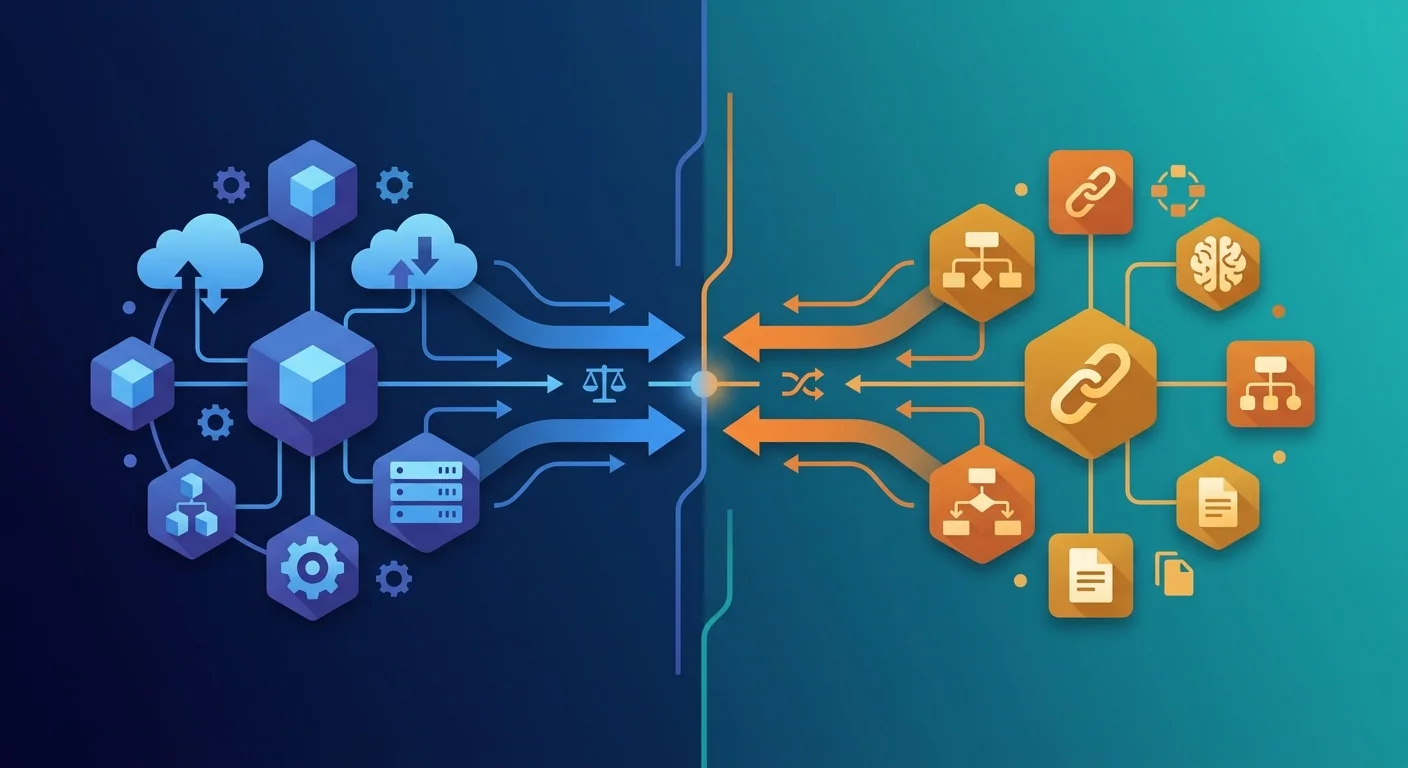
TL;DR: AWS Bedrock provides managed AI infrastructure with built-in models, enterprise security, and serverless deployment, while LangChain offers an open-source framework with maximum flexibility and model-agnostic design. Choose AWS Bedrock when you need managed infrastructure, enterprise compliance, and are committed to AWS ecosystem. Choose LangChain when you need vendor flexibility, fine-grained control, or are building across multiple cloud providers.
Key Takeaways
- AWS Bedrock is a managed platform providing foundation models, agent runtime, and enterprise infrastructure without managing servers or model deployments.
- LangChain is an open-source development framework offering composable abstractions for chains, agents, and tools across any model provider or cloud environment.
- AWS Bedrock excels at production deployment with auto-scaling, IAM security, and compliance certifications, while LangChain excels at rapid prototyping and architectural flexibility.
- LangChain supports 50+ model providers including OpenAI, Anthropic, Google, local models, and AWS Bedrock itself, making it cloud-agnostic.
- AWS Bedrock follows pay-per-token pricing for model inference plus infrastructure costs, while LangChain is free but you pay for your own hosting and API calls.
- The two are complementary rather than mutually exclusive — teams commonly build agent logic with LangChain and deploy on AWS infrastructure for production.
What is AWS Bedrock and how does it relate to LangChain?
AWS Bedrock is Amazon's fully managed service for building generative AI applications using foundation models from leading AI companies. It provides serverless access to models from Anthropic (Claude), Meta (Llama), Amazon (Titan), Cohere, AI21 Labs, and Stability AI through a unified API. Beyond model access, Bedrock includes AgentCore for deploying production AI agents with managed runtime, memory, code execution, and tool integration capabilities.
LangChain is an open-source framework for developing applications powered by large language models. Originally released in late 2022, it has become the most widely adopted LLM application framework, with libraries for Python and JavaScript. LangChain provides abstractions for composing chains of operations, building autonomous agents with tool use, managing conversation memory, and implementing retrieval-augmented generation (RAG) pipelines.
The relationship between AWS and LangChain is complementary. LangChain includes native integrations for AWS Bedrock models through the langchain-aws package, allowing developers to build LangChain applications that call Bedrock models. Conversely, AWS infrastructure can host LangChain applications deployed as Lambda functions, ECS containers, or EC2 instances. Teams often use LangChain's framework for agent logic and AWS services for production infrastructure.
Quick Comparison: AWS Bedrock vs LangChain
What are the core differences in architecture and design?
AWS Bedrock is a vertically integrated platform. It provides the complete stack: foundation models, inference infrastructure, agent runtime (AgentCore), memory management, tool integration via Model Context Protocol (MCP), and security through IAM. This tight integration reduces configuration overhead but operates within AWS boundaries. You select models from Bedrock's catalog, deploy agents on Bedrock's runtime, and integrate tools through Bedrock Gateway.
LangChain takes a horizontal, composable approach. Every component is an abstraction with interchangeable implementations. Models can come from any provider — OpenAI, Anthropic, Google, Bedrock, local deployments, or custom APIs. Memory can be backed by Redis, PostgreSQL, DynamoDB, or custom stores. Tools can be Python functions, MCP servers, API wrappers, or any callable. This composability provides maximum control but requires developers to ensure components work together correctly.
The architectural philosophy difference manifests in code structure. Bedrock applications make API calls to managed services that handle orchestration. LangChain applications compose in-process objects that the developer orchestrates. Bedrock handles infrastructure complexity; LangChain handles application complexity.
For teams building their first AI agent, Bedrock's integrated approach is faster because it removes infrastructure decisions. For teams with complex requirements spanning multiple clouds, needing custom model deployments, or requiring highly specific agent behaviors, LangChain's composability is essential.
How do deployment and infrastructure differ?
This is where the fundamental difference between managed platform and open-source framework becomes most apparent.
AWS Bedrock provides managed deployment through AgentCore Runtime. You define your agent logic, specify an entrypoint and health check, and call the runtime's launch method. Bedrock handles containerization, ECR image storage, auto-scaling configuration, endpoint provisioning, load balancing, health monitoring, and CloudWatch logging. The deployment target is always AWS infrastructure within your chosen region.
LangChain has no built-in deployment mechanism. You build your agent, then deploy it using standard cloud patterns — as a FastAPI server on EC2, a Lambda function with function URLs, a Docker container on ECS or Kubernetes, a Cloud Run service on GCP, or a local process. This flexibility is powerful but means you handle all operational concerns: container orchestration, scaling policies, health checks, security hardening, monitoring dashboards, and incident response.
The operational impact is significant. A Bedrock agent scales automatically from zero to thousands of requests without configuration. A LangChain agent requires explicit scaling rules, load balancer configuration, and potentially multi-region deployment planning.
What about model access and flexibility?
AWS Bedrock provides curated access to 30+ foundation models through a unified API. The catalog includes Claude 3.5 Sonnet, Claude 3 Opus, Llama 3.3, Mistral Large, Amazon Titan, Command R+, and Jurassic-2. You enable models per-region through the AWS console, then call them via InvokeModel or higher-level agent APIs. Bedrock handles model hosting, scaling, and version management.
Model selection is constrained to what Bedrock offers. If you need GPT-4, Gemini, or a custom fine-tuned model hosted elsewhere, you cannot access it through Bedrock's native APIs. The trade-off is operational simplicity — models are always available, scaled automatically, and covered by AWS compliance certifications.
LangChain supports 50+ model providers through interchangeable integrations. The same agent code works with OpenAI models, Anthropic models via API, Anthropic models via Bedrock, Google Gemini, local Ollama deployments, self-hosted vLLM servers, Azure OpenAI, or custom model endpoints. Switching providers requires changing configuration, not rewriting logic.
This flexibility matters for multi-cloud strategies, model benchmarking, cost optimization by provider, and building on models Bedrock does not offer. The cost is managing multiple API keys, handling different rate limits, and ensuring consistent behavior across providers.
How does tool integration and MCP support compare?
Model Context Protocol (MCP) is the emerging standard for connecting AI agents to external tools and data sources. Both AWS and LangChain support MCP but with different philosophies.
AWS Bedrock Gateway provides managed MCP endpoints with built-in authentication (OAuth/JWT), credential management, and protocol translation. You define tools targeting Lambda functions or API endpoints, and Gateway handles security at the platform level. The managed approach provides enterprise-grade authentication, audit logging through CloudTrail, and IAM-based access control.
LangChain MCP integration through langchain-mcp-adapters supports both stdio and SSE transports, multi-server connections, and automatic conversion between MCP tools and LangChain's StructuredTools. You can connect to multiple MCP servers simultaneously, use their tools alongside native LangChain tools, and run MCP servers locally or remotely.
Beyond MCP, LangChain has a significantly larger built-in tool ecosystem. Over 100 integrations cover web search (Tavily, SerpAPI), databases (SQL, MongoDB, Redis), file systems, vector stores, APIs (GitHub, Jira, Slack), and web browsers. Bedrock focuses on a smaller set of managed capabilities: code execution, browser automation, and API/Lambda integration through Gateway.
The choice depends on requirements. For enterprises needing centralized authentication, audit trails, and compliance documentation, Bedrock Gateway provides the infrastructure. For teams building custom toolchains, needing local tool servers, or integrating diverse external services, LangChain offers more flexibility.
What are the pricing models and total cost considerations?
AWS Bedrock pricing has three components: model inference (pay-per-token), agent infrastructure (AgentCore Runtime compute time), and additional services (Memory operations, Code Interpreter execution, Browser sessions, Gateway API calls). Model pricing varies by model — Claude 3.5 Sonnet costs approximately $3 per million input tokens and $15 per million output tokens as of 2026. Runtime pricing follows Lambda-style compute charges. All pricing is pay-as-you-go with no upfront commitments.
LangChain is free and open-source under the MIT license. Your costs are:
- LLM API calls to model providers (OpenAI, Anthropic, etc.)
- Infrastructure hosting (EC2, ECS, Lambda, or other cloud compute)
- Storage for memory and vector databases
- Optional paid services: LangSmith for observability (free tier available) and LangGraph Platform for managed deployment
For a production agent handling 1 million requests per month with average 500 tokens per request, approximate costs:
AWS Bedrock total cost:
- Model inference (Claude 3.5): ~$2,000-3,000
- AgentCore Runtime: ~$500-1,000 (based on Lambda-equivalent pricing)
- Memory/tools: ~$200-500
- Total: ~$2,700-4,500/month
LangChain self-hosted on AWS:
- Model API calls (same model via Bedrock or direct): ~$2,000-3,000
- ECS Fargate or Lambda hosting: ~$300-800
- RDS/Redis for memory: ~$100-300
- Total: ~$2,400-4,100/month
The cost difference is minimal for many workloads. Bedrock provides more predictable pricing and eliminates infrastructure management time. LangChain provides more cost optimization opportunities through provider comparison, local models, and infrastructure tuning, but requires engineering time.
When should you choose AWS Bedrock?
Choose AWS Bedrock when:
- Your organization is committed to AWS infrastructure and uses other AWS services
- You need managed deployment with auto-scaling and minimal DevOps overhead
- Enterprise security and compliance certifications (SOC 2, HIPAA, GDPR) are required
- Your team lacks dedicated platform engineers to manage agent infrastructure
- You want built-in IAM-based access control and CloudTrail audit logging
- Your application fits within Bedrock's supported models and tool integration patterns
- You need managed browser automation or sandboxed code execution without container management
- Time-to-production is more valuable than infrastructure cost optimization
When should you choose LangChain?
Choose LangChain when:
- You need vendor flexibility to work across multiple cloud providers or local deployments
- Your application requires access to models not available on Bedrock (GPT-4, Gemini, custom models)
- You want fine-grained control over agent architecture and execution flow
- Your team has existing infrastructure expertise and prefers managing deployment stacks
- You are building prototypes and need to iterate quickly on agent designs
- You need the largest ecosystem of integrations, tools, and community resources
- Your application is multi-language (Python and JavaScript/TypeScript)
- You want to benchmark multiple model providers or optimize costs across vendors
- You need mature MCP integration with multi-server support and custom transports
How do memory and state management compare?
AWS Bedrock Memory is a managed service providing hierarchical context storage organized by actors and sessions. It includes semantic search over conversation history, custom memory strategies, and automatic persistence. You create a memory instance, store conversation events, and query using natural language. The service handles indexing, vector embeddings, and retrieval without managing databases.
LangChain provides memory as pluggable abstractions. The ConversationBufferMemory, ConversationSummaryMemory, VectorStoreRetrieverMemory, and custom implementations cover different use cases. LangGraph extends this with checkpointing for stateful workflows, enabling time-travel debugging and human-in-the-loop patterns.
For simple conversational agents with one user, both work well. For enterprise applications with thousands of concurrent users needing persistent memory with semantic search, Bedrock Memory eliminates operational overhead. For applications needing custom memory strategies, integration with existing databases, or specialized retrieval logic, LangChain's flexibility is necessary.
What monitoring and observability capabilities exist?
AWS Bedrock integrates natively with CloudWatch for metrics, logs, and alarms. Agent runtime logs flow automatically to CloudWatch Logs. You can set alarms on invocation count, error rate, latency percentiles, and token usage. CloudTrail provides audit logs for all API calls including model access and tool invocations. X-Ray tracing is available for distributed agent workflows.
LangChain has no built-in observability. For production monitoring, teams use:
- LangSmith (official paid service): Provides tracing, debugging, evaluation, and monitoring specifically for LangChain applications. Free tier for small projects.
- Generic APM tools: Datadog, New Relic, Elastic APM with custom instrumentation
- Open-source alternatives: OpenTelemetry with Jaeger or Zipkin, Prometheus for metrics
- Custom logging: Application logs with structured JSON for parsing
LangSmith is the most LangChain-native solution, showing full execution traces with LLM calls, tool invocations, token counts, and latency breakdowns. However, it requires separate setup and potentially additional cost. Teams already using other APM tools may prefer integrating LangChain into existing observability infrastructure.
The operational burden is higher for LangChain because observability is not included by default. Bedrock's built-in CloudWatch integration is immediately available without additional configuration.
Can AWS and LangChain work together?
Yes, and this combination is common in production environments. The integration works in both directions:
LangChain calling AWS Bedrock models:
LangChain agents deployed on AWS infrastructure:
Deploy LangChain applications as Lambda functions, ECS containers, or on EC2, using AWS services for hosting while maintaining LangChain's framework flexibility.
LangChain logic on Bedrock Runtime:
Build agent orchestration with LangChain's composable abstractions, then deploy on AgentCore Runtime for managed scaling and operations. This provides the best of both: development flexibility and operational simplicity.
The complementary nature means teams do not face a binary choice. Start with LangChain for rapid prototyping and architectural flexibility. When moving to production, evaluate whether AWS infrastructure (with or without Bedrock's managed services) provides operational value for your specific requirements.
What are the learning curves and developer experience?
AWS Bedrock requires AWS knowledge. Developers need familiarity with IAM roles, VPCs, CloudWatch, and AWS SDK patterns. The AgentCore API surface is relatively small — five main components with clear boundaries. AWS documentation is comprehensive but AWS-ecosystem-specific. The learning curve is moderate for teams already on AWS, steeper for teams new to AWS infrastructure.
LangChain has a large API surface. The framework includes abstractions for chains, agents, tools, memory, callbacks, document loaders, text splitters, embeddings, vector stores, retrievers, output parsers, and more. Documentation is extensive with many examples, but the breadth of functionality creates cognitive overhead. The learning curve is moderate to steep depending on use case complexity.
Developer experience differs by preference. AWS Bedrock feels like managed infrastructure — you configure services and make API calls. LangChain feels like an application framework — you compose objects and call methods. Teams with DevOps backgrounds often prefer Bedrock's service-oriented model. Teams with software engineering backgrounds often prefer LangChain's framework-oriented model.
Community and ecosystem size matters for learning. LangChain has a larger open-source community with more third-party tutorials, courses, and integrations. AWS Bedrock has official AWS support, professional services, and Well-Architected Framework guidance. For troubleshooting, LangChain has more Stack Overflow answers and GitHub issues; Bedrock has AWS support tickets and Solution Architects.
Conclusion: Which should you choose?
AWS Bedrock and LangChain solve different problems in the AI agent stack. Bedrock answers "how do I deploy and operate AI applications with enterprise infrastructure?" LangChain answers "how do I build flexible, composable AI agent logic?"
For teams building on AWS with enterprise requirements, Bedrock provides the fastest path to production with managed infrastructure, automatic scaling, and built-in compliance. For teams needing vendor flexibility, building across clouds, or requiring custom architectures, LangChain provides the necessary control and composability.
The optimal approach for many production applications is using both: build agent logic with LangChain's rich abstractions and ecosystem, then deploy on AWS infrastructure (potentially including Bedrock AgentCore Runtime) for managed operations. This separates application concerns from infrastructure concerns, allowing each tool to solve what it does best.
As the AI infrastructure landscape evolves, standards like Model Context Protocol are making frameworks increasingly interoperable. Whatever you choose today, designing agents with clean abstractions and minimal framework-specific coupling will make it easier to adapt as the ecosystem matures.
Frequently Asked Questions
What is the difference between AWS Bedrock and LangChain?
AWS Bedrock is a managed platform providing foundation model access, agent runtime infrastructure, and enterprise AI services through AWS. LangChain is an open-source framework for building LLM applications with composable abstractions across any model provider or cloud. Bedrock handles infrastructure and operations; LangChain handles application architecture and orchestration. They are complementary rather than competing — you can build agents with LangChain and deploy on AWS infrastructure.
Can I use LangChain with AWS Bedrock?
Yes, LangChain has native AWS Bedrock integration through the langchain-aws package. You can use Bedrock models (Claude, Llama, Titan, etc.) in LangChain applications by configuring the ChatBedrock or BedrockLLM classes. This combination provides LangChain's framework flexibility with AWS managed model hosting. Many teams use this pattern: LangChain for agent logic, Bedrock for model access, and AWS infrastructure for deployment.
Is AWS Bedrock cheaper than using LangChain with direct API calls?
Costs are similar for many workloads. Bedrock model pricing is competitive with direct API calls to providers like Anthropic or OpenAI. The difference is infrastructure cost: Bedrock includes managed runtime, scaling, and monitoring in infrastructure charges, while LangChain requires you to pay for hosting separately (EC2, Lambda, ECS, etc.). For high-volume production applications, self-managed LangChain on optimized infrastructure can be cheaper, but requires engineering time. For most applications, the cost difference is 10-20% while the operational overhead difference is significant.
Which has better tool integration: AWS Bedrock or LangChain?
LangChain has broader tool integration with 100+ built-in integrations covering web search, databases, file systems, APIs, and more. AWS Bedrock focuses on fewer, highly managed capabilities: Lambda/API integration via Gateway, sandboxed code execution, and cloud browser automation. For MCP (Model Context Protocol) support, Bedrock Gateway provides managed endpoints with enterprise authentication, while LangChain supports stdio and SSE transports with multi-server connections. Choose LangChain for integration breadth and flexibility; choose Bedrock for managed security and compliance.
Can I deploy LangChain agents on AWS without using Bedrock?
Yes, LangChain agents can deploy on any AWS compute service without Bedrock: Lambda functions with function URLs, ECS/Fargate containers, EC2 instances, or EKS clusters. You manage deployment, scaling, and monitoring yourself. This approach provides maximum flexibility — you can use any model provider (OpenAI, Anthropic API, self-hosted models) while running on AWS infrastructure. Bedrock is optional for teams that want AWS-managed model hosting and agent runtime.
What are the main advantages of AWS Bedrock over LangChain?
AWS Bedrock's main advantages are managed infrastructure with automatic scaling, built-in IAM security and compliance certifications, zero DevOps overhead for model hosting and agent deployment, integrated CloudWatch monitoring without additional setup, and enterprise support from AWS. Bedrock eliminates operational concerns that LangChain leaves to the developer. Choose Bedrock when time-to-production, compliance requirements, and operational simplicity outweigh the value of framework flexibility.
Subscribe to the newsletter
About the Author
Aaron is an engineering leader, software architect, and founder with 18 years building distributed systems and cloud infrastructure. Now focused on LLM-powered platforms, agent orchestration, and production AI. He shares hands-on technical guides and framework comparisons at fp8.co.
Cite this Article
Related Articles
AWS AgentCore Explained: 5 Tools for Production AI Agents
Complete Python walkthrough of AgentCore Memory, Runtime, Code Interpreter, Browser, and Gateway. Build enterprise AI agents on AWS without managing infra.
AI AgentsAgentCore vs LangChain: 2026 Framework Guide
Compare AgentCore and LangChain for AI agents. Architecture, pricing, and deployment trade-offs explained with code.
AI EngineeringHow to Build AI Agents: 5 Frameworks with Code (2026)
Step-by-step guide to building AI agents with LangChain, CrewAI, AutoGen, Strands, and AgentCore — runnable code and a basic agent for each framework.
AI Agents