How to Build AI Agents: 5 Frameworks with Code (2026)
Step-by-step guide to building AI agents with LangChain, CrewAI, AutoGen, Strands, and AgentCore — runnable code and a basic agent for each framework.
TL;DR: AI agent frameworks provide the runtime loop, tool integration, memory management, and orchestration primitives needed to build autonomous LLM-powered systems. LangChain offers the broadest ecosystem and CrewAI simplifies multi-agent coordination. AutoGen enables conversational agent networks, Strands provides minimal model-driven control, and AgentCore delivers fully managed production infrastructure.
Key Takeaways
- LangChain's ecosystem spans 400+ integrations and handles 85% of common agent patterns, but its abstraction layers add 200-500ms latency overhead per tool call in complex chains.
- CrewAI reduces multi-agent system development from weeks to hours with role-based agent definitions, sequential/parallel execution modes, and built-in delegation — ideal for teams without distributed systems expertise.
- AutoGen's conversational architecture enables emergent collaboration between specialized agents through message passing, achieving 40% better results on complex research tasks compared to single-agent approaches.
- Strands Agents SDK gives the LLM full control over the agent loop with minimal framework interference, producing 60% less boilerplate code but requiring stronger models to maintain execution quality.
- AgentCore eliminates infrastructure management entirely with managed compute, auto-scaling, built-in memory, and IAM-native security — reducing time-to-production from months to days at the cost of AWS lock-in.
- Production teams increasingly compose multiple frameworks: one for orchestration logic, another for deployment, and a third for lightweight tool-calling — no single framework wins across all dimensions.
This page owns the implementation intent: use it when you want runnable code
and a basic agent in each framework. If the unresolved question is enterprise
selection, compliance, durable execution, or operational ownership, start with
Agent Orchestration Frameworks 2026
and return here after choosing the operating model.
What are AI agent frameworks?
An AI agent framework is a software library or managed platform that provides the core primitives for building autonomous systems powered by large language models. These primitives include the agent loop (the observe-think-act cycle that drives autonomous behavior), tool integration interfaces, memory and state management, and orchestration patterns for multi-step or multi-agent workflows.
The distinction between calling an LLM API directly and using an agent framework is autonomy. A direct API call produces a single response. An agent framework wraps that call in a loop: the model observes its environment (tool outputs, user messages, memory state), decides on an action, executes it, observes the result, and repeats until the task is complete or a termination condition is met. The framework handles the plumbing — serializing tool calls, managing conversation state, enforcing guardrails, routing between models, recovering from errors, and persisting memory across sessions.
Without a framework, teams rebuild these primitives from scratch for every project. Authentication for tool calls, retry logic for failed API requests, context window management as conversations grow, state serialization for long-running tasks — these cross-cutting concerns consume 60-70% of development time when built ad hoc. Frameworks encode best practices and battle-tested patterns so teams can focus on their specific application logic.
By 2026, the landscape consolidated from dozens of experimental libraries into five production-viable options, each reflecting a fundamentally different opinion about how much control the developer versus the model should have over execution flow.
How do AI agent frameworks work?
Every agent framework implements a variation of the same fundamental execution loop. Understanding this shared architecture reveals where the frameworks diverge and why those differences matter for production systems.
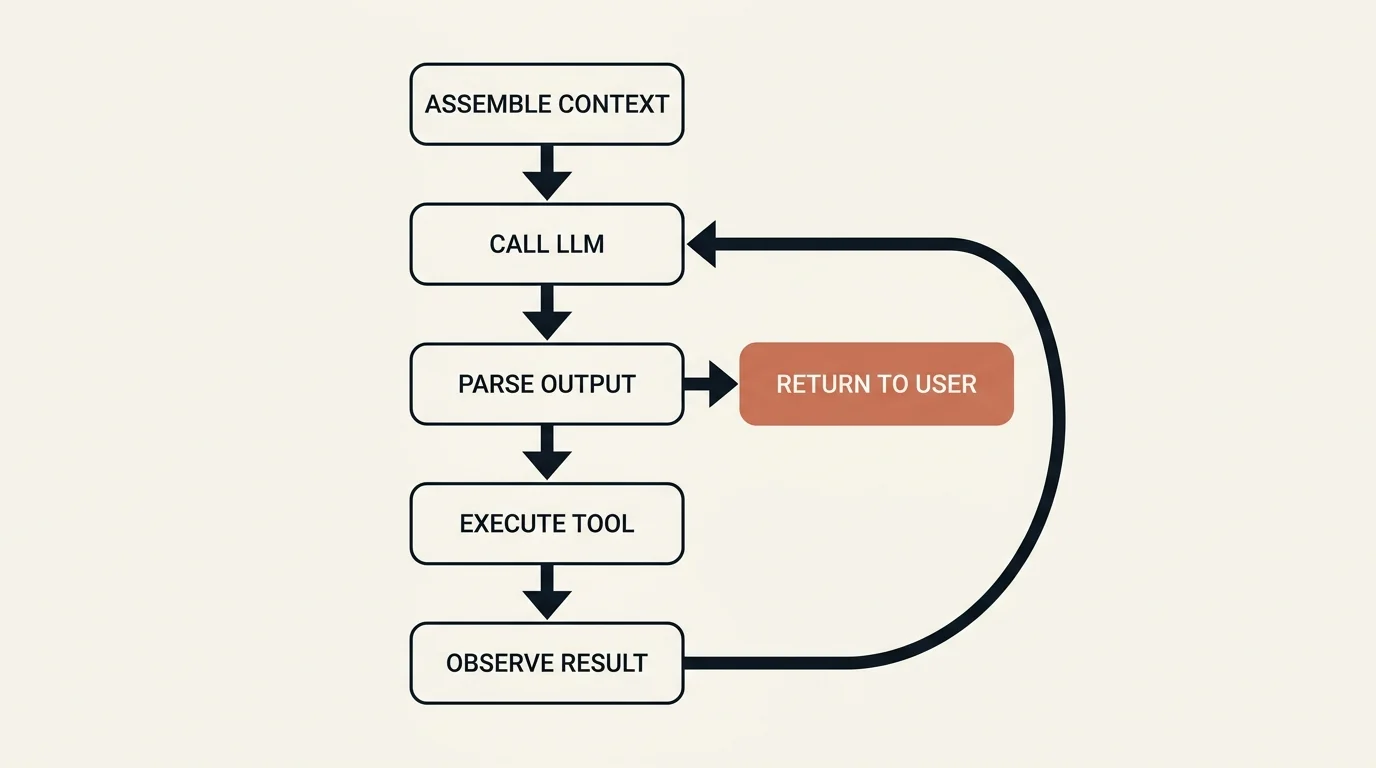
Every framework runs the same five stages: (1) assemble context — system prompt + memory + tool definitions + history + observations from the last step; (2) call the LLM with that context; (3) parse the output — if it's plain text, return the response to the user or next agent; (4) otherwise execute the tool — validate args, run it, capture the result; (5) observe the result — append it to context and loop back to step 2.
The frameworks diverge across four architectural dimensions that determine their suitability for different use cases:
State management. How does the framework track what the agent knows and has done? LangChain uses in-memory state with optional persistence backends. LangGraph (LangChain's graph layer) provides explicitly typed state objects with checkpointing at every node — enabling time-travel debugging and replay. AgentCore provides fully managed memory with semantic search across sessions. CrewAI maintains shared context accessible to all crew members. Strands lets the model manage its own context with minimal framework interference.
Tool integration. All frameworks support function calling via model-native tool_use APIs. The differences are in discovery (static registration vs. MCP dynamic discovery), execution environment (AgentCore provides isolated containers; LangChain executes in-process), error handling (Strands surfaces raw errors directly to the model; LangGraph can route to recovery nodes), and composability (how easily tools can be chained or nested).
Orchestration topology. This is where frameworks differ most fundamentally. Linear chains (basic LangChain), directed graphs with cycles and conditional edges (LangGraph), hierarchical delegation with role-based routing (CrewAI), peer-to-peer conversational message passing (AutoGen), and flat model-driven loops where the LLM decides everything (Strands) represent incompatible philosophies about control flow.
Memory architecture. Short-term (conversation buffer), working memory (current task state), and long-term (persistent across sessions) are handled differently by each framework. AgentCore provides all three as managed services. LangChain requires composing memory backends. Strands relies on the model's context window as its only memory, with external persistence left to the developer.
How does LangChain work as an agent framework?
LangChain is the most widely adopted general-purpose framework, with 95,000+ GitHub stars and the largest ecosystem of third-party integrations. Its architecture centers on composable "chains" — sequences of operations that transform inputs to outputs through LLM calls, tool invocations, and data transformations.
Core architecture. LangChain provides Runnables as its fundamental abstraction — any component that takes input and produces output. Chains compose runnables sequentially or in parallel. Agents are chains that include an LLM decision step determining which tool to call next. LangGraph extends this with directed state graphs for complex workflows.
Strengths. The ecosystem is unmatched: 400+ integrations for vector stores, document loaders, LLM providers, and tools. Documentation and community resources are extensive. Most online tutorials and examples use LangChain, making it the default starting point for new agent developers.
Weaknesses. Abstraction layers add overhead — both cognitive (understanding the chain/runnable model) and computational (200-500ms per tool call in complex chains). Debugging through multiple abstraction layers is difficult. The framework changes rapidly, with breaking API changes between minor versions.
Best for: Rapid prototyping, teams with diverse integration needs, applications that benefit from the extensive ecosystem of pre-built components.
How does CrewAI work as an agent framework?
CrewAI models multi-agent systems as crews of role-based agents that collaborate on tasks. Each agent has a defined role, goal, and backstory that shapes its behavior, and tasks are assigned to agents based on their specialization.
Core architecture. CrewAI's three primitives are Agents (role-based LLM instances), Tasks (discrete units of work with expected outputs), and Crews (coordinated groups of agents executing tasks). Execution modes include sequential (agents work in order), hierarchical (a manager agent delegates), and parallel (independent tasks run simultaneously).
Strengths. The role-based abstraction maps naturally to how humans think about delegation. Setting up a research crew with a "Researcher" agent, "Analyst" agent, and "Writer" agent is intuitive and requires minimal code. Built-in delegation means agents can ask each other for help without developer-specified routing logic.
Weaknesses. Less control over individual agent behavior compared to graph-based approaches. The role-based abstraction can be limiting for workflows that don't map to human team structures. Performance overhead from inter-agent communication through the framework layer.
Best for: Multi-agent workflows that mirror human team structures, content generation pipelines, research and analysis tasks, teams that prefer declarative configuration over imperative code.
How does AutoGen work as an agent framework?
AutoGen (Microsoft) treats multi-agent coordination as conversations between specialized agents. Agents communicate through message passing, with each agent processing messages according to its role and capabilities. The conversation itself is the orchestration mechanism.
Core architecture. AutoGen agents are conversable entities that send and receive messages. GroupChat coordinates multi-agent conversations with configurable speaker selection (round-robin, random, or LLM-selected). UserProxyAgent bridges human users into agent conversations. AssistantAgent provides pre-configured LLM-powered agents with tool access.
Strengths. The conversational paradigm enables emergent collaboration — agents build on each other's outputs naturally. Complex reasoning tasks benefit from multiple specialized perspectives. The architecture supports both fully autonomous and human-in-the-loop workflows through the same conversation mechanism.
Weaknesses. Conversational overhead means more total tokens consumed compared to direct orchestration. Speaker selection in large groups (5+ agents) becomes unreliable without careful prompt engineering. Debugging conversations with many participants is challenging due to the lack of explicit control flow.
Best for: Research tasks requiring multiple perspectives, code generation with review loops, scenarios where emergent agent collaboration produces better results than scripted workflows.
How does Strands Agents SDK work as an agent framework?
Strands Agents SDK (open-sourced by AWS in 2025) takes a model-driven approach with minimal abstraction. The core philosophy: the LLM controls the entire agent loop, and the framework provides tools and execution infrastructure while staying out of the way.
Core architecture. A Strands agent is defined in approximately 10 lines of code: a model, a system prompt, and a list of tools. The framework handles the loop mechanics (calling the model, executing tool calls, feeding results back) but imposes no workflow structure, state management, or routing logic. The model decides what to do at every step.
Strengths. Extreme simplicity — 60% less boilerplate than equivalent LangChain agents. The model-driven approach leverages improvements in model capability directly; as models get smarter, Strands agents get better without code changes. Easy to understand, debug, and modify because there are minimal framework abstractions to reason about.
Weaknesses. Less deterministic execution since the model controls flow entirely. No built-in checkpointing, state management, or recovery mechanisms. Requires stronger models to maintain quality — weaker models make worse decisions when given full control. Limited multi-agent support compared to CrewAI or AutoGen.
Best for: Simple tool-calling agents, prototypes that need to ship fast, applications where model capability is sufficient to drive the entire workflow, teams that prefer minimal framework overhead.
How does AgentCore work as an agent framework?
Amazon Bedrock AgentCore is the only fully managed runtime for production AI agents. Rather than a library you install, it provides cloud infrastructure that handles compute, scaling, memory, identity, and observability — so teams focus on agent logic rather than operational concerns.
Core architecture. AgentCore provides managed building blocks: Agent Runtime (serverless compute that scales to zero), Memory (persistent semantic and episodic memory), Code Interpreter (sandboxed code execution), Identity (IAM-native authentication and authorization), and Observability (built-in tracing and monitoring). Agents can be written in any framework (LangChain, Strands, custom) and deployed on AgentCore infrastructure.
Strengths. Zero infrastructure management — no GPU provisioning, no container orchestration, no memory backend maintenance. Security is handled through AWS IAM rather than custom auth layers. Auto-scaling from zero to thousands of concurrent agents without configuration. Built-in memory eliminates the need to build and maintain persistent storage.
Weaknesses. AWS lock-in — once agents depend on AgentCore's managed memory and identity, migrating off AWS is expensive. Less flexibility than self-managed infrastructure for custom execution patterns. Pricing model can be unpredictable for workloads with irregular traffic patterns.
Best for: Teams already on AWS who need production-grade agent infrastructure without dedicated platform engineers, enterprise deployments requiring IAM-native security, applications that need elastic scaling.
When should you choose each framework?
The decision depends on your team's constraints, your application's requirements, and your operational maturity. This decision matrix maps common scenarios to framework recommendations:
Start with Strands if your agent needs fewer than 10 tools and the model is capable enough to drive execution without help. The minimal overhead makes iteration fast.
Graduate to LangGraph when you need deterministic control flow, human-in-the-loop checkpoints, or complex branching logic that the model cannot reliably manage alone.
Choose CrewAI or AutoGen when the problem requires multiple specialized agents working together. CrewAI for structured delegation, AutoGen for emergent collaboration.
Deploy on AgentCore when moving to production and you need enterprise-grade infrastructure without a dedicated platform team.
How do you implement a basic agent with these frameworks?
The following example illustrates the same simple agent — a weather lookup with tool use — implemented in each framework, showing the philosophical differences in practice.
Strands (model-driven, minimal code):
LangChain (ecosystem-rich, composable):
CrewAI (role-based, multi-agent):
The code complexity scales differently as agents grow. Strands stays simple but offers less control. LangChain adds components but provides more customization hooks. CrewAI shines when multiple agents need to collaborate on the task.
What are common pitfalls when choosing an agent framework?
Over-engineering with heavy frameworks. Teams choose LangGraph for simple chatbots that need one tool. The graph abstraction adds cognitive load and debugging complexity without providing value. Start simple, add framework complexity only when the problem demands it.
Ignoring operational requirements. A framework that works in a Jupyter notebook may not scale to production. Consider logging, error recovery, scaling, monitoring, and deployment from day one. AgentCore handles these automatically; self-managed frameworks require explicit engineering investment.
Framework lock-in before validation. Building deeply on a framework's abstractions before validating that the agent approach works creates expensive rewrites. Prototype with Strands or raw API calls first, then add framework structure once the agent design is proven.
Choosing based on GitHub stars, not architecture fit. LangChain's popularity does not make it the best choice for every use case. A multi-agent research pipeline benefits more from AutoGen's conversational architecture than from LangChain's chain abstraction, regardless of star counts.
FAQ
Which AI agent framework is best for beginners in 2026?
Strands Agents SDK offers the lowest barrier to entry — a working agent requires 10 lines of Python code with no complex abstractions to learn. For beginners who want more structure and educational resources, LangChain provides the most tutorials, courses, and community support. Start with Strands to understand how agents work, then explore LangChain when you need specific integrations or more complex patterns.
Can you use multiple agent frameworks together?
Yes, and production teams increasingly do. A common pattern uses LangGraph for orchestration logic (defining the workflow graph with human-in-the-loop checkpoints), Strands for individual tool-calling agent nodes (lightweight, model-driven execution), and AgentCore for deployment infrastructure (managed compute, memory, scaling). The frameworks are complementary rather than mutually exclusive.
How much does it cost to run AI agents in production?
Agent costs depend on three factors: LLM API costs (typically $0.01-$0.15 per agent invocation depending on model and token usage), infrastructure costs (self-hosted: $2-10/hour per GPU; managed: pay-per-invocation on AgentCore), and tool execution costs (API calls, compute time for code execution). A customer support agent handling 10,000 daily conversations typically costs $500-2,000/month in total, with LLM tokens being the dominant expense.
Should I read this or the architectural comparison first?
Read whichever matches what you are stuck on. This page is the implementation walkthrough: runnable code for a basic agent in each of the five frameworks, so you can get something working today. Agent Orchestration Frameworks 2026: 6 Best Compared is the architectural comparison — the decision matrix, where each framework locks you in, and a decision path that settles the choice in five questions. If you have not chosen yet, decide there and build here.
Do AI agent frameworks support open-source models?
All major frameworks support open-source models served through compatible APIs. LangChain integrates with Ollama, vLLM, and any OpenAI-compatible endpoint. Strands supports any Bedrock-compatible model including self-hosted options. The key requirement is that the model must support tool calling (function calling) — not all open-source models do. Llama 3, Mistral, and Command R+ all support tool calling and work well with these frameworks.
What comes next for AI agent frameworks?
The framework landscape is converging on several trends that will shape 2026 and beyond.
Protocol standardization. Model Context Protocol (MCP) is becoming the universal standard for tool discovery and integration. Frameworks that embrace MCP will offer plug-and-play tool ecosystems; those that don't will face integration friction as the ecosystem standardizes.
Managed runtimes. The operational burden of running agents is pushing teams toward managed services. Just as serverless replaced server management for web applications, managed agent runtimes like AgentCore are replacing self-managed agent infrastructure. The framework becomes the logic layer; the cloud provides everything else.
Composability over monoliths. Rather than one framework handling everything, the trend is toward composing specialized tools: one framework for orchestration, another for deployment, a protocol for tool integration, and managed services for memory and observability. The winning strategy is selecting the best tool for each layer rather than accepting compromises from an all-in-one framework.
Evaluation-driven development. As agents grow more autonomous, testing shifts from unit tests to evaluation suites that measure agent behavior across hundreds of scenarios. Frameworks that integrate evaluation natively — tracking success rates, failure modes, and regression across versions — will dominate production deployments where reliability is non-negotiable.
The frameworks covered in this guide represent the current state of the art, but the field moves quickly. The architectural patterns — agent loops, tool integration, memory management, orchestration topologies — will persist even as specific implementations evolve. Understanding these patterns equips you to evaluate new frameworks as they emerge and make informed decisions about which tools serve your specific production requirements.
Subscribe to the newsletter
About the Author
Aaron is an engineering leader, software architect, and founder with 18 years building distributed systems and cloud infrastructure. Now focused on LLM-powered platforms, agent orchestration, and production AI. He shares hands-on technical guides and framework comparisons at fp8.co.
Cite this Article
Related Articles
Best Frameworks For Building AI Agents 2026: Complete Guide
Compare the best frameworks for building AI agents in 2026: LangChain, CrewAI, LangGraph, Strands, AgentCore, and AutoGen evaluated on architecture, production readiness, and use cases.
AI Agent DevelopmentLangChain vs Strands: Agent Framework Comparison 2026
Compare LangChain vs Strands for AI agents: configurable abstractions vs model-driven simplicity, with code examples and decision criteria.
AI EngineeringLangChain vs Bedrock: Which AI Framework to Choose?
LangChain vs Bedrock compared: architecture, deployment, memory, tool integration, pricing, and production readiness for AI agents in 2026.
AI Engineering