Agent Orchestration Frameworks 2026: 6 Best Compared
Agent orchestration frameworks 2026 compared: LangChain, AgentCore, LangGraph, CrewAI, AutoGen and Strands on coordination, memory, cost and deployment.

TL;DR: Choose orchestration by the control you need: LangChain for configurable agents, LangGraph for explicit stateful workflows, CrewAI for role-based delegation, and Strands for a model-driven loop. Compare AgentCore Harness for a managed loop and Runtime for hosting your own agent. AutoGen remains relevant to existing systems, but its maintainers now direct new users to Microsoft Agent Framework.
Key Takeaways
- This page owns framework selection and operating-model decisions; the implementation tutorial owns the code walkthrough.
- AgentCore Runtime and an orchestration library can be combined; AgentCore Harness additionally offers a managed loop, so the wider platform is not just hosting.
- Checkpoints preserve a thread's execution state; a cross-thread store serves a different memory requirement.
- Multi-agent coordination needs a concrete reason, such as separate tool permissions or independent review, rather than an assumed quality advantage.
- The six products in the title define this comparison's scope. They are not an exhaustive market ranking or six equivalent orchestration libraries.
- Compare actual releases on a bounded workload. This guide contains no measured latency, cold-start, cost, or success-rate ranking.
Which framework should you shortlist first?
The official sources below were checked September 11, 2026. The recommended acceptance checks are editorial guidance, not benchmark results.
For a new Microsoft-based project, also evaluate the successor named by the AutoGen maintainers. That maintenance status is more decision-relevant than a stale GitHub-star count.
What are AI agent frameworks?
An agent framework supplies some of the execution loop, tool interfaces, state handling, and lifecycle controls around model calls. The application still defines success, permissions, allowed tools, and recovery behavior.
A model can return a tool request without a framework; a framework can make coordinating the surrounding work easier. Conversely, a workflow with a fixed sequence may need ordinary application code rather than autonomous tool selection. Do not infer reliable autonomy merely from the presence of an agent loop.
How do AI agent frameworks work?
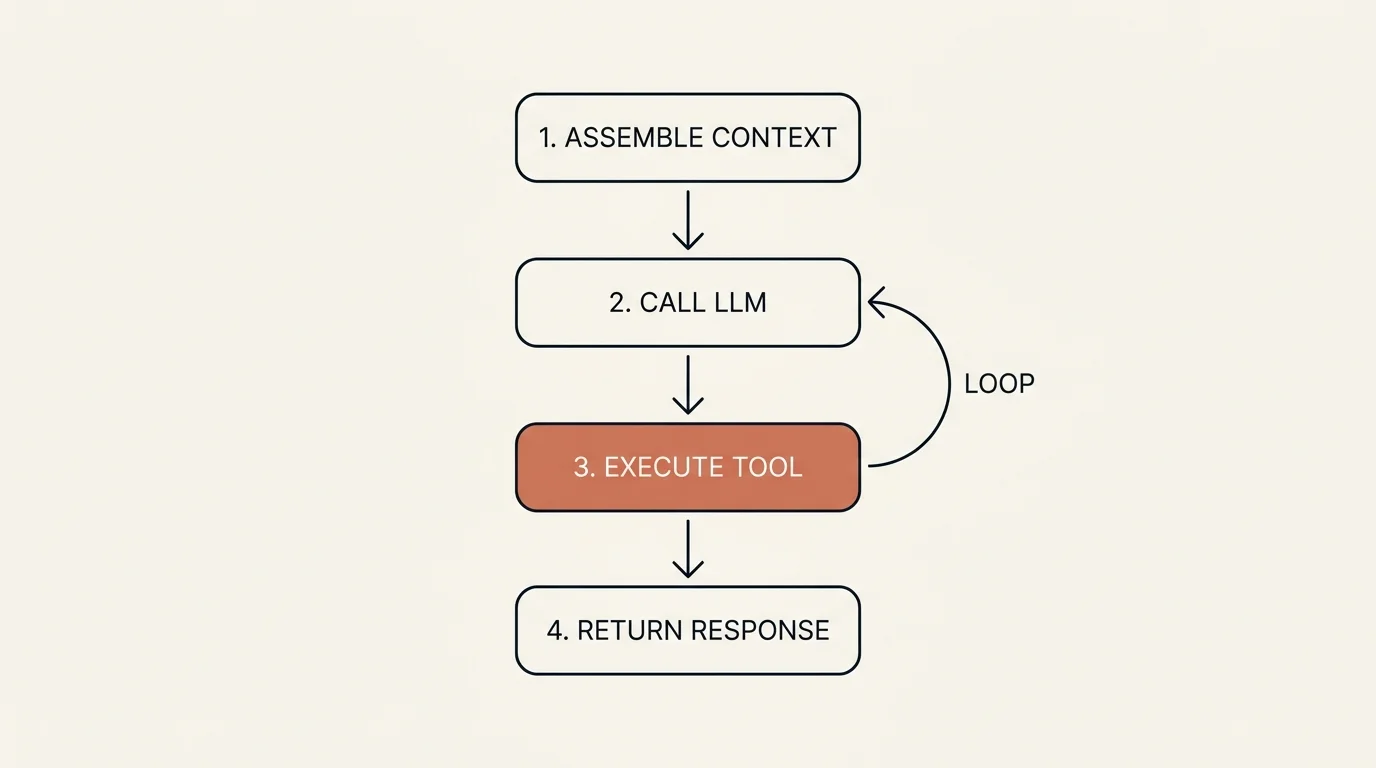
A typical tool-using loop assembles context, calls the model, validates any proposed tool invocation, executes permitted actions, and adds the observed result to the next turn. A final response or an application limit ends the run.
The diagram is conceptual. Frameworks differ in how they schedule steps, preserve state, expose interruptions, and recover from failures. The application must verify external outcomes; a tool response alone does not prove a business action completed.
How do the six choices compare?
Avoid interpreting “open framework” as “zero migration cost.” Tool schemas, checkpoints, stored memory, and provider behavior can still create dependencies.
What changed in the documented framework choices?
The current LangChain overview documents create_agent and distinguishes configurable agents from lower-level LangGraph orchestration. Old version labels and constructors should not be used as a current installation baseline.
AWS documents AgentCore support for different frameworks and models, including models outside Bedrock. Its services can be used independently. The earlier “five services, Bedrock models only” description was too restrictive.
AutoGen's repository now declares maintenance mode and directs new users to Microsoft Agent Framework. Its existing conversational patterns remain useful to understand, but this guide does not recommend adopting it solely because it appeared in an older comparison.
For every candidate, record the package release and documentation version selected. A stable concept such as checkpointing does not make a copied SDK example version-independent.
What is LangChain and when should you use it?
LangChain provides configurable agents and integrations for models and tools. Its current agent abstraction uses LangGraph underneath. Inspect it when you want to compose an agent without designing every execution primitive yourself.
The trade-off is an additional API and dependency surface. Validate the behavior your application needs, including streaming, tool errors, structured output, and persistence. There is no measured basis here for a fixed milliseconds-per-step overhead or a claim that removing the framework always improves latency.
What is Amazon Bedrock AgentCore?
AgentCore provides Harness for a managed agent loop, Runtime for hosting your own code, and supporting services such as Memory, Gateway, Browser, and Code Interpreter, with identity and observability capabilities described in the developer guide.
Evaluate managed Harness when its configurable loop fits; bring LangChain, LangGraph, or another implementation to Runtime when you need to own orchestration. AgentCore is not the only managed hosting option, and adopting Runtime does not require every supporting service. Check region, connectivity, identity, and data requirements before choosing it.
No cold-start benchmark was run for this article. Measure the selected deployment and report the environment and sample size before making a latency claim. The AgentCore vs LangChain comparison covers this layer distinction in detail.
What is LangGraph and how does it differ?
LangGraph provides explicit workflow execution and persistence primitives. Its persistence documentation distinguishes thread-scoped checkpoints from stores containing information across threads. Configure a durable backend when state must survive process restarts.
Inspect LangGraph when branching, human approval, or recovery needs an explicit state model. Checkpointing does not automatically make an external action exactly-once: an interrupted payment, email, or database write still needs an application-level replay/idempotency contract.
What are CrewAI and AutoGen for multi-agent systems?
CrewAI organizes work around agents, tasks, and processes. Its process documentation describes sequential and hierarchical processes; a parallel task execution option should not be confused with a universal third process type.
AutoGen's documentation describes conversational agent systems. Read it together with the maintenance notice in its repository. Neither role-based delegation nor message passing proves better reasoning on your task.
Conceptual example: a researcher produces source references and a reviewer checks whether the proposed answer follows from those references. Evaluate whether separating the roles catches errors that a simpler workflow misses, while including the extra model calls and failure modes in the comparison.
When does Strands fit?
The Strands repository describes a model-driven SDK with lifecycle controls. Inspect it when you want the model to choose among tools inside an application-owned process.
Keep the execution bounded and define state ownership. A model-driven loop is not permission to run indefinitely, and it does not remove the need to persist session state or inspect tool outcomes. Use the documentation for the installed language package and release rather than assuming the project is limited to an old Python-only interface.
How do you build a production AI agent?
Start with a bounded task and an explicit operating contract. The following is conceptual pseudocode, not a runnable provider SDK or a tested reference implementation:
Choose budget values from the workload. A check made after a model response can detect overspending but cannot retroactively cap that response; enforce request limits before calls and retain provider usage records afterward. The implementation tutorial is the next step after choosing the operating model.
How should an enterprise compare agent frameworks?
Use Agent Memory for persistence boundaries and LangSmith vs Langfuse vs Phoenix for trace and evaluation checks.
Which mistakes make a comparison misleading?
Do not compare a one-tool demonstration in one framework with a multi-agent workflow in another and attribute all latency to the framework. Keep task inputs, model configuration, tools, environment, and success criteria aligned.
Do not treat more agents as a quality guarantee or a fixed number of turns as a universal context limit. Inspect context engineering when history grows, and measure the specific workload before choosing compaction or retrieval policies.
Finally, preserve failures and incomplete runs in the results. A framework selection exercise that records only successful demonstrations cannot estimate production reliability.
FAQ
What is the best AI agent framework for beginners?
Begin with a bounded task and one or two well-defined tools. Inspect LangChain or Strands if their abstractions fit, then add explicit orchestration when the workflow requires it. There is no measured universal beginner winner in this guide.
How do AI agent frameworks handle memory?
Separate current conversation state, execution checkpoints, and durable information across sessions. LangGraph documents checkpointers and stores; AgentCore documents managed memory. The application chooses storage, identity scope, retention, and deletion behavior.
Can you combine multiple agent frameworks?
Yes, provided the interfaces are compatible and state ownership is explicit. A common architectural option is application-level orchestration hosted on AgentCore Runtime. Validate cancellation, retries, and checkpoints at the boundary rather than assuming frameworks compose automatically.
What's the difference between agents and chains?
A fixed workflow chooses the sequence in application code. A tool-using agent can choose actions from observations at runtime. Many applications combine deterministic steps with model-selected actions; use autonomy only where the task needs it.
Are these the latest six best frameworks for every project?
No. The title identifies the comparison's existing scope, not an exhaustive ranking. AutoGen's maintenance status in particular changes its suitability for new projects. Use the dated official sources and your operating requirements to create a shortlist.
Is this guide the same as the tutorial on building agents?
This page covers selection and operating trade-offs. How to Build AI Agents covers implementation. For a narrower architectural decision, read AgentCore vs LangGraph or Strands vs LangGraph.
Do frameworks enforce every production guardrail automatically?
No. Verify each requirement in the installed configuration: execution budgets, tool permissions, identity, persistence, and recovery. A managed runtime or an agent loop does not establish that application-level limits and authorization have been implemented.
Sources
Subscribe to the newsletter
About the Author
Aaron is an engineering leader, software architect, and founder with 18 years building distributed systems and cloud infrastructure. Now focused on LLM-powered platforms, agent orchestration, and production AI. He shares hands-on technical guides and framework comparisons at fp8.co.
Cite this Article
Related Articles
AgentCore vs LangChain: 2026 Framework Guide
Compare AgentCore and LangChain for AI agents. Architecture, pricing, and deployment trade-offs explained with code.
AI EngineeringAgentCore vs LangGraph: Agent Orchestration Compared (2026)
Compare AgentCore and LangGraph for AI agent orchestration. State management, deployment, and pricing explained with code.
AI EngineeringContext Engineering for AI Agents: Cost and Reliability
Learn how caching, tool selection, memory and retrieval shape agent context, with cost calculations, failure cases and an evaluation checklist.
AI Engineering